Sealing freshly roasted coffee inside a barrier pouch without a functional coffee degassing valve causes internal gauge pressure to climb past 30 to 100+ kPa (0.3 to 1.0+ bar), which ruptures heat seals, fractures thin aluminum barrier layers, or forces roasters to leave beans exposed to staling air in open bins before packing. Conversely, fitting a one way degassing valve whose elastomeric seat is fouled by coffee fines or depleted of capillary silicone oil creates an oxygen leak of 2.0 to 15.0+ cm³/day that destroys fresh thiol aroma weeks before the printed shelf-life date.
In our food and flavour section, the parent analysis on packaging and food expectations noted that trade reports describe a one-way valve as expected to maintain coffee aroma, flavor, and quality without supplying a sensory panel score. Understanding what the valve actually controls—and where its mechanical authority stops—requires separating three physical domains:
- Mass-transfer kinetics of roasted coffee CO₂ offgassing: How pyrolysis and Strecker degradation at
195–225 °Ctrap2 to 10 mL of CO₂ per gram(4 to 12 L/kg) inside microporous bean cell walls, and how Fickian diffusion, bi-exponential desorption, and Weibull relaxation govern gas release across light versus dark roasts and whole beans versus ground coffee (200–800 µm). - Microfluidic check-valve mechanics: How a five-layer internal button valve (
18–22 mmPE/PPflange,60–150 µmnon-woven filter mesh, elastomeric rubber or polyisobutylene diaphragm,21 CFR § 178.3570viscoelastic silicone oil capillary seal, and vented retainer cap) cycles between its cracking pressure (P_open = 2.5–6.5 mbar) and reseating pressure (P_close = 0.5–2.0 mbar). - Oxygen barrier budgets and sensory route boundaries: How laminate Oxygen Transmission Rate (
ASTM D3985OTR < 0.05 to 1.50 cm³/(m²·day·atm)) and valve seat integrity protect2-furfurylthioland coffee lipids below0.5%–1.0%headspaceO₂—and why squeezing a retail coffee bag to sniff the valve plume samples dry-gas orthonasal olfaction rather than hot-water retronasal extraction in the cup.
Quick Engineering & Sensory Specifications
| Subsystem or Parameter | Quantitative Specification / Governing Standard | Physical Mechanism & Sensory Boundary |
|---|---|---|
| Roast gas generation window | 195–225 °C (383–437 °F) internal bean temperature (Baggenstoss et al., 2008) |
Maillard reactions, Strecker degradation, and polysaccharide pyrolysis generate 85%–90%+ CO₂, 5%–8% CO, H₂O, N₂, and trace VOCs. |
Total retained CO₂ yield (M_∞) |
1.0%–2.0% dry bean mass = 10–20 mg CO₂/g = 2.0–10.5 mL CO₂/g (4–12 L CO₂/kg at 20 °C, 101.3 kPa) (Smrke et al., 2018) |
Scales with roast depth (Agtron 65–75 light: 2.0–4.5 mL/g; Agtron 25–40 dark: 7.5–10.5+ mL/g) and species (C. canephora Robusta > C. arabica). |
Whole bean vs. ground D_eff |
Whole bean (7–9 mm): D_eff = 1.0 × 10⁻¹¹ to 8.0 × 10⁻¹¹ m²/s (14–30+ d tail). Ground (200–800 µm): 40%–75% lost in 15–60 min (5×–15× faster flux) |
Grinding shortens diffusion radius R by 10×–35×, cutting characteristic diffusion time (τ ~ R²/D_eff) by 100×+ and venting macropore gas during milling. |
| Valveless pouch overpressure | 30–100+ kPa (300–1,000+ mbar / 0.3–1.0+ bar / 4.4–14.5+ psi) internal gauge pressure in a sealed 1 kg bag |
Causes pillow-pack foil pinholing (15–40 kPa), ASTM F88 heat-seal creep (30–80 kPa), or high-altitude burst at 75–80 kPa ambient pressure. |
Valve cracking pressure (P_open) |
Retail coffee valve: 2.5–6.5 mbar (250–650 Pa / 0.036–0.094 psi). Bulk industrial liner valve: 10–35 mbar (1,000–3,500 Pa) (Goglio S.p.A.) |
Upward headspace force (F = ΔP × A_disc) lifts the perimeter of the elastomeric membrane against preload and silicone fluid adhesion to vent excess CO₂. |
Valve reseating pressure (P_close) |
Retail coffee valve: 0.5–2.0 mbar (50–200 Pa; minimum seal threshold >= 0.1–0.5 mbar) |
Membrane elasticity and capillary meniscus tension (21 CFR § 178.3570 silicone fluid) snap the disc shut before ΔP drops to 0 mbar, keeping a positive CO₂ blanket. |
Package O₂ barrier budget |
Foil laminate (ASTM D3985): < 0.05–0.10 cm³/(m²·day·atm). Seated valve (ASTM F1307): 0.005–0.030 cm³ O₂/(valve·day) |
Fines-fouled or dry-seat valves leak 2.0–15.0+ cm³ O₂/day (100×–1,000× spike), pushing headspace O₂ past the < 0.5%–1.0% threshold that protects 2-furfurylthiol. |
| Valve sniff vs. brewed cup | Dry headspace plume (20–25 °C partition K_air/bean) vs. 90–96 °C aqueous brew extraction (Le Quéré & Schoumacker, 2023) |
Squeezing the bag vents volatile sulfurs/diketones (methanethiol, 2,3-butanedione) to the nostrils while purging the CO₂ blanket; it never measures retronasal cup flavor. |
Roasted coffee CO₂ offgassing: why sealed pouches build pressure
Roasted coffee CO₂ offgassing is the post-roast desorption of carbon dioxide and co-generated pyrolysis gases synthesized and pressurized inside the cellular microstructure of the coffee bean at 195–225 °C. When green coffee beans are heated past endothermic drying (100–160 °C) into the exothermic roasting window (190–225 °C), three overlapping reaction pathways generate gas faster than it can escape through dense polysaccharide cell walls:
- Maillard & Strecker degradation (
170–210 °C): Reducing sugars react with amino acids to form Amadori intermediates, and subsequent Strecker degradation of amino acids by α-dicarbonyls decarboxylates the carbon skeleton, releasingCO₂alongside Strecker aldehydes (2-methylpropanal,3-methylbutanal) and pyrazines (Baggenstoss et al., 2008). - Chlorogenic acid & trigonelline cleavage (
195–220 °C): Caffeoylquinic acids hydrolyze and decarboxylate into quinic acid lactones, catechol, and hydroxyhydroquinone (HHQ), while trigonelline demethylates into nicotinic acid and pyridines. - Polysaccharide pyrolysis (
205–225 °C, First to Second Crack): Above first crack (~196–205 °C) and into second crack (~220–225 °C), arabinogalactans, galactomannans, and cellulose microfibrils undergo pyrolytic decarboxylation.
Time-resolved gravimetric and gas-chromatographic studies (Smrke et al., 2018) show that CO₂ accounts for 85% to 90%+ of the total gas volume trapped in freshly roasted coffee. The remaining 10%–15% comprises carbon monoxide (CO, ~5%–8%), water vapor (H₂O), nitrogen (N₂), and trace volatile organic compounds (VOCs—aldehydes, furans, ketones, diketones, and sulfur thiols) that represent under 0.1% of gas mass but carry the aroma profile.
Total CO₂ yield by roast degree (Agtron) and botanical species
Immediately after cooling, freshly roasted whole-bean coffee retains 1.0% to 2.0% of its dry mass as trapped CO₂ (10 to 20 mg CO₂/g). At standard temperature and pressure (STP, 20 °C, 101.3 kPa, where 1 mg CO₂ = 0.546 mL), this inventory equals 2.0 to 10.5 mL of releasable CO₂ per gram, or 4.0 to 12.0 liters of CO₂ per 1 kg bag (1.0 to 3.0 L per 250 g pouch). Total gas capacity (M_∞) and initial desorption rate (k_1) scale with roast degree (Agtron Gourmet scale) and species (Coffea arabica vs. Coffea canephora):
| Roast Profile & Thermal Endpoint | Agtron Gourmet Score | Retained CO₂ Mass (mg/g) |
Releasable CO₂ Volume (mL/g or L/kg at STP) |
Bean Porosity (ε) & Cell-Wall Microstructure |
Initial 24 h Offgassing Fraction |
|---|---|---|---|---|---|
Light Roast (195–202 °C, past 1st crack) |
Agtron 65 – 75 |
3.7 – 8.2 mg/g |
2.0 – 4.5 mL/g (2.0 – 4.5 L/kg) |
Low void fraction (ε ≈ 0.38–0.44); thick intact cell walls (20–30 µm pores) restrict radial diffusion. |
18% – 28% of M_∞ (0.5 – 1.2 L/kg) |
Medium Roast (205–214 °C, City / Full City) |
Agtron 45 – 60 |
8.2 – 13.7 mg/g |
4.5 – 7.5 mL/g (4.5 – 7.5 L/kg) |
Moderate micropore expansion (ε ≈ 0.45–0.52); substantial CO₂ dissolved in 11%–17% coffee oil phase. |
28% – 36% of M_∞ (1.4 – 2.7 L/kg) |
Dark Roast (215–225 °C, at/past 2nd crack) |
Agtron 25 – 40 |
13.7 – 19.2+ mg/g |
7.5 – 10.5+ mL/g (7.5 – 12.0 L/kg) |
High void fraction (ε ≈ 0.55–0.65); cellulose wall fracturing at 2nd crack creates rapid initial burst (k_1). |
35% – 45% of M_∞ (2.8 – 5.0 L/kg) |
Robusta vs. Arabica (matched Agtron 50) |
Agtron 50 |
Robusta +15% – 30% higher |
Robusta 6.5 – 9.5 mL/g vs. Arabica 5.0 – 7.0 mL/g |
C. canephora (Robusta) develops higher open microporosity and faster initial k_1 than C. arabica (Smrke et al., 2018). |
Robusta 35%–42% in 24 h vs. Arabica 28%–35% |
Three thermodynamic storage states and Fickian radial diffusion
Inside the roasted bean matrix, CO₂ coexists in three thermodynamic states that explain why whole beans require 14 to 30+ days to degas:
- Compressed free gas in macropores and mesopores (
> 50 nm): PressurizedCO₂(500–1,500 kPalocal pore pressure at roast discharge) in fractured cell lumens that vents first via Darcy and Knudsen flow. - Dissolved
CO₂in the liquid lipid phase (11%–17%coffee oil): Triglycerides and diterpene esters absorbCO₂under Henry’s Law (C_oil = k_H × P_CO2), acting as an internal buffer reservoir. - Physisorbed and chemisorbed
CO₂in sub-nanometer micropores (< 2 nm): Molecules bound inside ultramicroporous melanoidin-polysaccharide walls, requiring thermal activation (E_a ≈ 20–32 kJ/mol) to desorb.
Macroscopic radial mass transfer from a spherical bean of equivalent radius R (3.5–4.5 mm) follows Fick’s Second Law:
∂C/∂t = D_eff × (∂²C/∂r² + (2/r) × ∂C/∂r)
In intact whole roasted beans at 20–25 °C, effective diffusivity D_eff is only 1.0 × 10⁻¹¹ to 8.0 × 10⁻¹¹ m²/s. Because characteristic diffusion time scales as τ_diff = R² / (π² × D_eff), a R = 4.0 × 10⁻³ m bean with D_eff = 2.5 × 10⁻¹¹ m²/s has a single e-folding decay constant of:
τ_diff = (4.0 × 10⁻³ m)² / (9.87 × 2.5 × 10⁻¹¹ m²/s) = 64,777 s ≈ 18.0 hours
Because CO₂ escapes simultaneously from fast macropore channels and slow nanopore/lipid reservoirs, food engineers model cumulative desorption M(t) (in mL/g or L/kg at time t in hours) with a two-compartment bi-exponential equation or a Weibull relaxation model (Smrke et al., 2018):
Bi-Exponential Model: M(t) = M_∞ × [1 − a · exp(−k_1 · t) − (1 − a) · exp(−k_2 · t)]
Weibull Model: F(t) = M(t) / M_∞ = 1 − exp(−(t / α)^β)
Where M_∞ is total releasable CO₂ (4.0–12.0 L/kg), a is the fast macropore fraction (0.35–0.55), k_1 is the fast initial rate constant (0.08–0.25 h⁻¹, governing hours 0–24), k_2 is the slow nanopore/lipid rate constant (0.003–0.012 h⁻¹, governing days 2–30+), α is the Weibull scale time to release 63.2% of M_∞ (40–120 h for whole beans vs. 0.5–4.0 h for ground coffee), and β is the shape parameter (0.45–0.75).
Whole bean vs. ground coffee (200–800 µm): why milling vents 40%–75% of CO₂ in under an hour
Milling intact beans (2R = 7,000–9,000 µm) into filter drip (500–800 µm) or espresso grinds (200–350 µm) cleaves sealed cell lumens and shortens the diffusion path R by 10× to 35×:
| Kinetic Parameter | Whole Bean Coffee (7,000–9,000 µm) |
Ground Coffee (200–800 µm) |
Packaging & Process Consequence |
|---|---|---|---|
Mean diffusion radius (R) |
3,500 – 4,500 µm (3.5–4.5 mm) |
100 – 400 µm (0.10–0.40 mm) |
Since τ_diff ∝ R², reducing R by 10×–35× shortens diffusion time by 100× to 1,200×. |
| Immediate grinding & 15–60 min loss | 5% – 10% of M_∞ in first hour post-roast |
40% – 75% of trapped CO₂ lost during milling and within 15–60 min |
Pressurized macropores rupture directly into the grinder chute and conveying air. |
| Apparent initial mass-transfer flux | Baseline (D_eff = 1.0×10⁻¹¹ – 8.0×10⁻¹¹ m²/s) |
5× to 15× higher initial desorption rate from fractured pore walls |
Co-evaporates low-boiling sulfur thiols and aldehydes unless packed immediately. |
| Cumulative 24-hour release | 30% – 40% of M_∞ (1.5–4.5 L/kg) |
75% – 90% of remaining CO₂ |
Whole bean pouches must vent 60%–70% of their total CO₂ inside the sealed package. |
| Time to 95% degassing completion | 14 to 30+ days (up to 45 d for dense light Arabica at < 20 °C) |
24 to 72 hours |
Vacuum brick packs require 2–8 h silo degassing of ground coffee; fresh whole beans require a one-way valve. |
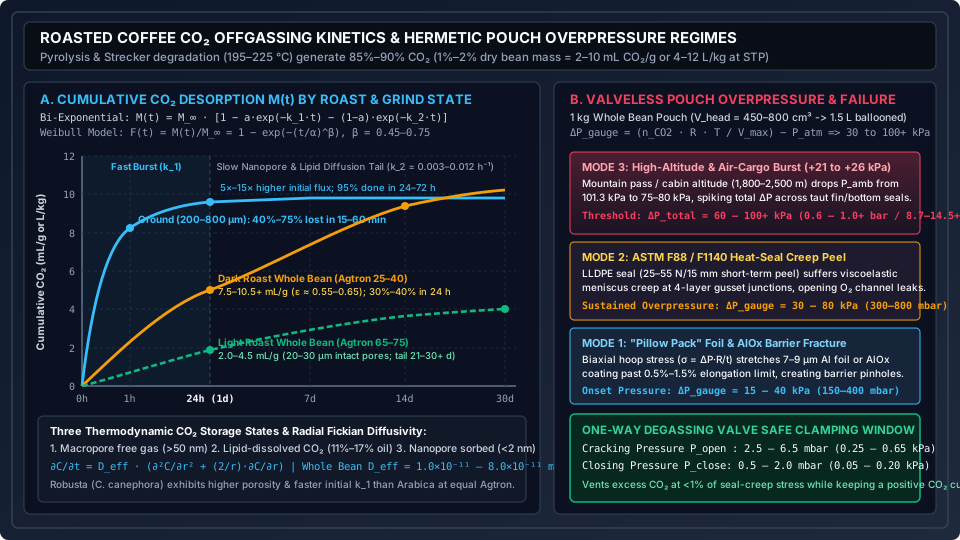
Figure 1: Bi-exponential and Weibull CO₂ desorption trajectories for ground coffee (200–800 µm) versus dark (Agtron 25–40) and light (Agtron 65–75) whole-bean roasts (left), paired with the internal gauge overpressure regimes (30–100+ kPa) and structural failure thresholds in valveless pouches (right).
Worked overpressure calculation and three structural failure modes in valveless pouches
Consider a 1.0 kg stand-up pouch of medium-dark whole-bean coffee (Agtron 40, M_∞ = 8.0 L CO₂/kg at 20 °C, 101.3 kPa, a = 0.42, k_1 = 0.14 h⁻¹, k_2 = 0.006 h⁻¹):
- Packed at
t = 1 hourpost-roast: Cumulative gas lost during cooling isM(1) = 8.0 × [1 − 0.42·exp(−0.14) − 0.58·exp(−0.006)] = 0.46 L/kg, leavingV_rem = 7.54 L(7,540 cm³) uncommitted inside the sealed pouch. - Packed after a
12-hourconditioning rest:M(12) = 8.0 × [1 − 0.42·exp(−1.68) − 0.58·exp(−0.072)] = 3.06 L/kgescapes in the silo, leavingV_rem = 4.94 L(4,940 cm³) inside the beans at sealing.
In a filled 1.0 kg gusseted pouch, initial interstitial and headspace void volume V_head,0 is 450 to 800 cm³ (0.45–0.80 L), expanding to V_max ≈ 1,200 to 1,500 cm³ (1.2–1.5 L) as the flexible walls balloon into a taut cylinder. Even with Henry’s Law back-pressure slowing desorption above 50–100 kPa, releasing 1.5 to 3.0 L of uncommitted CO₂ into V_max = 1.5 L produces an absolute internal pressure P_abs:
P_abs = P_initial + (n_desorbed × R × T) / V_max ≈ 101.3 kPa + (1,500 to 3,000 cm³ / 1,500 cm³) × 101.3 kPa = 202.6 to 303.9 kPa
Subtracting 101.3 kPa atmospheric pressure yields ΔP_gauge = 30 to 100+ kPa (300 to 1,000+ mbar / 0.30 to 1.0+ bar / 4.4 to 14.5+ psi), triggering three structural failure modes:
- Pillow-pack ballooning and brittle barrier fracture (
ΔP_gauge = 15–40 kPa): Biaxial hoop stress (σ_hoop = ΔP × R_pouch / t_film) strains the middle7–9 µmaluminum foil orAlOx/SiOxvapor-deposited barrier layer past its0.5%–1.5%fracture elongation limit, creating barrier pinholes that multiply filmOTRby10×–100×before the outerPET/LLDPElayers burst. - Viscoelastic heat-seal creep peel (
ΔP_gauge = 30–80 kPa, ASTM F88/F88M-23): Under ASTM F88/F88M-23 (evaluated on a linear peel strength tester), anLLDPEorCPPheat seal (25–55 N / 15 mmshort-term tensile peel) differs fundamentally from rigid container closures evaluated on a bottle cap torque tester or tracked via cap opening torque retention. Sustained30–80 kPainternal pressure causes viscoelastic polymer creep (ASTM F1140) along four-layer side-gusset junctions, opening microscopic channel leaks (10–100 µm). - High-altitude and air-freight barometric burst (
75–80 kPaambient pressure): Mountain pass trucking (1,800–2,500 m) or aircraft cargo pressurization (~2,400 mcabin altitude) drops external ambient pressure from101.3 kPato75–80 kPa(750–800 mbar), instantaneously adding+21 to +26 kPa(+210 to +260 mbar) of outward differential stress (ΔP_total = P_bag − P_ambient) that ruptures taut fin and bottom seals.
Rule of thumb: Any whole-bean coffee packed within 72 hours of roasting—or ground coffee packed within 4 hours of milling—will generate enough residual CO₂ to exceed 15 kPa (150 mbar) internal gauge pressure in a hermetic pouch and requires a one-way pressure-relief pathway.
Takeaway: Roasted coffee traps 4 to 12 L of CO₂ per kg across three internal pore and lipid states; without a one-way relief valve, multi-week whole-bean desorption or rapid post-grind release builds 30–100+ kPa gauge pressure that fractures foil barriers and creeps heat seals under ASTM F88.
Inside a one-way degassing valve: five layers and two pressure thresholds
Invented and patented in 1968 by Luigi Goglio (Goglio S.p.A., Milan) and produced in high-speed heat-seal and ultrasonic-weld formats by Goglio, Wipf AG (WICOVALVE), Syntegon, and Plitek, the internal button one way degassing valve is a passive microfluidic check valve. It contains no chemical sorbent and cannot distinguish CO₂ from O₂ by molecular weight; instead, it achieves unidirectional flow through five mechanical and fluidic layers calibrated across a narrow positive gauge pressure window.
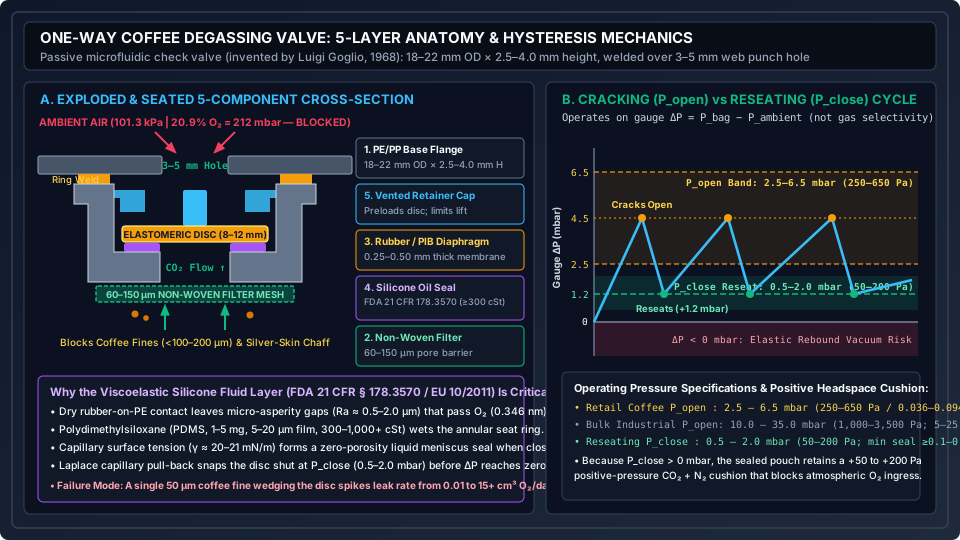
Figure 2: Exploded and seated five-layer anatomy of an internal button coffee degassing valve welded over a 3–5 mm pouch punch hole (left), paired with the differential pressure hysteresis cycle (P_open = 2.5–6.5 mbar versus P_close = 0.5–2.0 mbar) that preserves a positive internal CO₂ cushion (right).
Five-component internal construction and regulatory material specifications
Every internal button coffee degassing valve (outer flange diameter 18.0–22.0 mm, height 2.5–4.0 mm, mass 0.35–0.55 g) integrates five components along the exhaust path:
| Layer # | Valve Component | Material & Dimensional Specification | Mechanical & Mass-Transfer Function | Dominant Failure Mode if Degraded |
|---|---|---|---|---|
| 1 | Base Plate, Annular Seat & Seal Flange | Injection-molded LDPE/LLDPE or PP (18–22 mm OD) with a raised annular seat ring (Ra < 0.8 µm), welded over a 3.0–5.0 mm punched hole in the pouch web. |
Bonds hermetically to the inner sealant layer (PE-to-PE or PP-to-PP compatibility) and defines the planar sealing land. |
Incomplete ring weld or mismatched polymer (PE valve on CPP film) creates a perimeter bypass leak. |
| 2 | Particulate Micro-Filter Mesh (Product Side) | Circular non-woven spunbond polyolefin (PE/PP TNT), PET, or cellulose filter thermally bonded to the bottom inlet; 60 to 150 µm pore size. |
Passes gas (CO₂, N₂, VOCs) while blocking coffee fines (< 100–200 µm) and silver-skin chaff. |
Filter omission or delamination lets coffee fines migrate onto the valve seat, wedging the rubber disc open by 10–50 µm. |
| 3 | Elastomeric Disc Diaphragm | Die-cut or molded circular membrane (8.0–12.0 mm diameter, 0.25–0.50 mm thick) of vulcanized silicone rubber, EPDM, or polyisobutylene (PIB). |
Rests under central preload against the annular base seat; flexural modulus (Shore A 40–65) sets upward deflection at P_open. |
Elastomer compression set, coffee-oil swelling, or applicator overheating warps the disc and prevents flat reseating. |
| 4 | Viscoelastic Silicone Fluid Capillary Layer | 1 to 5 mg (5–20 µm wetting film) of food-grade polydimethylsiloxane (PDMS, 300 to 1,000+ cSt) compliant with 21 CFR § 178.3570 and EU 10/2011. |
Fills micro-asperities between the rubber disc and molded seat to form a zero-porosity capillary liquid meniscus (γ ≈ 20–21 mN/m). |
Under-dosing or dust absorption breaks the liquid bridge, increasing static O₂ permeation by 50×–500×. |
| 5 | Vented Retainer Cap Ring | Snap-fit or ultrasonically staked PE/PP top cap with central locating post and peripheral exhaust slots aligned with the 3–5 mm punch hole. |
Maintains central preload on the diaphragm and limits maximum upward lift during pallet compression. | External label or tape covering the 3–5 mm film punch hole blocks CO₂ exhaust and balloons the pouch. |
Why the 21 CFR § 178.3570 viscoelastic silicone fluid capillary seal is indispensable
Injection-molded PE or PP valve seats exhibit a microscopic surface roughness Ra of 0.5 to 2.0 µm (500–2,000 nm), whereas an oxygen molecule (O₂) has a kinetic diameter of 0.346 nm (0.000346 µm). At a gentle reseating pressure of 1 mbar (100 Pa), dry elastomer-on-polyolefin contact leaves interconnected roughness channels across the seat land through which atmospheric O₂ (21.2 kPa partial pressure outside vs. < 0.05 kPa inside) diffuses rapidly.
To seal those sub-micron channels, manufacturers meter 1 to 5 mg of food-grade dimethylpolysiloxane fluid (PDMS / silicone oil) onto the seat interface. Under U.S. FDA 21 CFR § 178.3570, dimethylpolysiloxane used in food-contact assemblies must have a minimum kinematic viscosity of >= 300 centistokes (cSt) (350–1,000 cSt in coffee valves). This 5–20 µm fluid film wets both surfaces (γ ≈ 20.5 mN/m at 25 °C) to create a continuous 360° liquid meniscus seal and generates a Young–Laplace capillary pull-down pressure (ΔP_capillary ≈ 2γ / h ≈ 4,100 Pa for h = 10 µm) that snaps the diaphragm shut before bag pressure drops to zero.
Cracking pressure (P_open) vs. reseating pressure (P_close) hysteresis
Because the diaphragm must overcome both central pin preload and liquid meniscus adhesion to lift open, its opening (cracking) pressure (P_open) is always higher than its closing (reseating) pressure (P_close):
- Cracking / opening threshold (
P_open = 2.5 to 6.5 mbar/250 to 650 Pafor retail valves): When ongoingCO₂desorption raises internal gauge pressureΔP = P_bag − P_ambientso that upward pneumatic force (F_up = ΔP × A_active,A_active ≈ 50–80 mm²) exceedsF_preload + F_capillary, the outer edge of the rubber disc lifts by10–50 µm, breaking the liquid meniscus and ventingCO₂through the3–5 mmfilm punch hole. (Heavy-duty industrial valves for5–25 kgbulk liners use stiffer membranes withP_open = 10 to 35 mbar/1,000 to 3,500 Pato withstand pallet stack loads.) - Reseating / closing threshold (
P_close = 0.5 to 2.0 mbar/50 to 200 Pa; minimum seal>= 0.1–0.5 mbar): As gas escapes andΔPdecays to0.5–2.0 mbar, elastic restoring force and PDMS capillary attraction snap the annular meniscus closed. - Retained positive-pressure
CO₂cushion (ΔP_residual = +0.5 to +2.0 mbar): BecauseP_close > 0 mbar, a sealed coffee pouch retains a permanent+50 to +200 Papositive internal gauge pressure ofCO₂andN₂, preventing atmosphericO₂(20.9%) from diffusing backward across the valve seat.
Rules of thumb:
- If
P_openexceeds10 mbar(1,000 Pa) on a250 gflexible retail pouch, the bag will visibly pillow before the valve cracks open. - If
P_closedrops to0.0 mbar(due to a dry seat or a50 µmcoffee fine wedged under the disc), atmospheric oxygen will diffuse backward through the exhaust hole as soon as active bean degassing slows.
Takeaway: A one-way degassing valve is a five-layer capillary check valve that cracks open at P_open = 2.5–6.5 mbar (250–650 Pa) to vent CO₂ and snaps shut via 21 CFR § 178.3570 silicone fluid surface tension at P_close = 0.5–2.0 mbar (50–200 Pa) to lock in a positive-pressure CO₂ blanket.
Oxygen barrier budgets: film OTR, valve leaks and the 1% headspace limit
Preserving roasted coffee aroma requires excluding molecular oxygen (O₂) from two oxygen-sensitive substrate classes:
- Ultra-trace volatile sulfur thiols (
2-furfurylthiolandmethanethiol):2-furfurylthiol(2-FFT) is the primary roasty impact odorant of fresh coffee, with a human odor detection threshold of~0.01 ppb(µg/L) in water (Baggenstoss et al., 2008). Müller and Hofmann (2007) demonstrated that when oxygen enters the package, phenolic roast products—specifically hydroxyhydroquinone (HHQ), catechol, and chlorogenic acid fragments—oxidize into electrophilic ortho-quinones that nucleophilically trap2-furfurylthiolinto odorless phenol/2-furfurylthiol conjugates or oxidize thiols into disulfides within days. - Roasted coffee lipids (
11% to 17%dry bean mass): Coffee oil (~40%–45%linoleic acid and~30%–35%palmitic acid) undergoes free-radical autoxidation in the presence ofO₂, forming rancid hexanal and(E)-2-nonenaloff-notes over multi-month storage.
Headspace O₂ concentration thresholds (< 0.5% to 1.0% O₂) and why CO₂ self-purging is not enough
Sealing freshly roasted coffee in ambient air (20.9% O₂) and relying on CO₂ offgassing alone to purge the headspace through the valve fails because a 250 g pouch with 450 cm³ void space traps ~94 cm³ (125 mg) of pure O₂ (500 mg O₂/kg of coffee). Because the headspace mixes continuously (C_O2(V) = C_O2,0 × exp(−V_CO2 / V_void)), average headspace O₂ across the first 48 hours remains between 3% and 12%—allowing 20–60 mg/kg of O₂ to chemisorb into the beans and oxidize HHQ into thiol-trapping quinones before dilution completes:
| Packaging Atmosphere Regime | Initial Headspace O₂ (% v/v) |
Trapped O₂ Mass per 250 g Bag (mg O₂) |
Specific O₂ Exposure (mg O₂ / kg coffee) |
Chemical Fate of 2-Furfurylthiol & Coffee Lipids |
Typical Sensory Stability Window |
|---|---|---|---|---|---|
| Unflushed Ambient Air + Valve | 20.9% O₂ (212 mbar P_O2) |
112 – 140 mg O₂ (84–105 cm³) |
448 – 560 mg O₂/kg |
Rapid quinone conjugate trapping of 2-FFT during the first 48–96 h before CO₂ dilution completes; early hexanal rise. |
Whole bean: 7 – 14 days; Ground: < 24 – 72 hours |
Marginal Modified Atmosphere (MAP) |
1.5% – 3.0% O₂ (15–30 mbar P_O2) |
8.0 – 20.0 mg O₂ (6–15 cm³) |
32 – 80 mg O₂/kg |
Measurable 2-FFT depletion within 3–6 weeks; fails export and supermarket specialty shelf-life targets. |
4 – 8 weeks |
High-Stability Commercial Target (N₂ Flush + Valve) |
< 0.5% to 1.0% O₂ (< 5–10 mbar P_O2) |
< 2.5 – 5.5 mg O₂ (< 2–4 cm³) |
< 10 – 22 mg O₂/kg |
Initial N₂ flush removes > 95% of air before sealing; subsequent CO₂ desorption sweeps residual O₂ below 0.2%, preserving 2-FFT and lipids. |
6 to 12+ months (sealed foil laminate) |
Total package oxygen ingress budget: ASTM D3985 laminate OTR + ASTM F1307 valve leak rate
Once a 250 g pouch (450 cm³ void space, film area A_film = 0.12 m²) is nitrogen-flushed to 0.5% O₂ (2.25 cm³ O₂), keeping headspace oxygen below the 1.0% O₂ staling threshold (4.50 cm³ O₂) over 180 days allows only 2.25 cm³ of cumulative O₂ ingress (<= 0.0125 to 0.025 cm³ O₂/day in air). Total daily package ingress J_O2,total combines film permeation (ASTM D3985-17 at 23 °C, 0% RH, scaled by 0.209 atm ambient O₂ partial pressure) and whole-package valve ingress (ASTM F1307):
J_O2,total (cm³ O₂/day in air) = (OTR_film × A_film × 0.209) + J_O2,valve
| Barrier Element / Laminate Structure | Standard OTR (ASTM D3985, 1 atm O₂, 23 °C) |
WVTR (ASTM F1249, 38 °C, 90% RH) |
Daily O₂ Ingress in Air (0.209 atm O₂, 0.12 m² Pouch) |
180-Day Cumulative O₂ Ingress (cm³ O₂) |
Shelf-Life & Recycling Classification |
|---|---|---|---|---|---|
Aluminum Foil Triplex (PET 12 µm / Al Foil 7–9 µm / LLDPE 80 µm) |
< 0.05 – 0.10 cm³/(m²·day·atm) |
< 0.05 – 0.10 g/(m²·day) |
0.0013 – 0.0025 cm³ O₂/day |
0.23 – 0.45 cm³ O₂ (+0.05%–0.10% headspace O₂) |
12–18 month benchmark; multi-material non-recyclable in mono-polyolefin streams. |
Metallized PET Triplex (PET 12 µm / VMPET 12 µm / LLDPE 80 µm) |
0.30 – 1.00 cm³/(m²·day·atm) |
0.30 – 1.00 g/(m²·day) |
0.0075 – 0.0251 cm³ O₂/day |
1.35 – 4.52 cm³ O₂ (+0.30%–1.00% headspace O₂) |
3–6 month specialty retail; susceptible to Al vapor-coat flex-cracking at gusset folds. |
Recyclable High-Barrier Mono-Polyolefin (BOPE / EVOH-PE or AlOx/SiOx-BOPP/PP) |
0.50 – 1.50 cm³/(m²·day·atm) |
1.00 – 3.50 g/(m²·day) |
0.0125 – 0.0376 cm³ O₂/day |
2.25 – 6.77 cm³ O₂ (+0.50%–1.50% headspace O₂) |
3–6 month recyclable target when paired with a matching PE (#4) or PP (#5) valve; EVOH barrier degrades above 75% RH. |
Clean Seated One-Way Degassing Valve (Intact 21 CFR 178.3570 PDMS oil + 60–150 µm mesh) |
0.005 – 0.030 cm³ O₂/(valve·day) (ASTM F1307 package delta) |
< 0.01 g/(valve·day) |
+0.005 – 0.030 cm³ O₂/day |
0.90 – 5.40 cm³ O₂ (+0.20%–1.20% headspace O₂) |
Compatible with 6–12 month stability; valve ingress accounts for 65%–90% of total O₂ entering a foil pouch. |
| Contaminated or Dry-Seat Degassing Valve (Coffee fine wedged under disc or depleted oil) | 2.0 – 15.0+ cm³ O₂/(valve·day) (100× to 1,000× leak spike) |
Elevated convective vapor exchange | +2.0 – 15.0+ cm³ O₂/day |
360 – 2,700+ cm³ O₂ (equilibrates to 20.9% O₂ in 7–21 days) |
Catastrophic barrier failure: completely negates a < 0.05 cm³/(m²·day) aluminum foil laminate. |
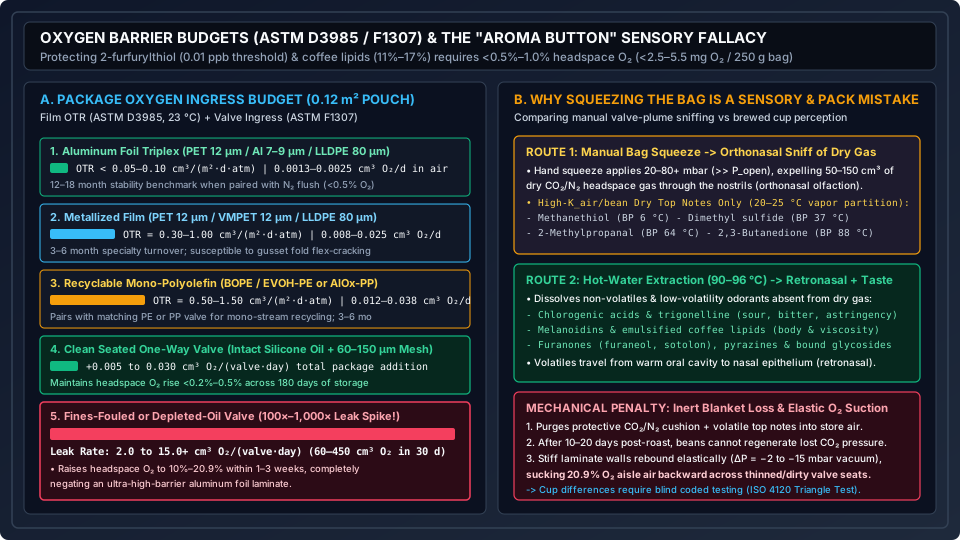
Figure 3: Daily oxygen ingress budgets (ASTM D3985 film permeation plus ASTM F1307 valve seat leakage) for a 0.12 m² pouch (left), contrasted with the chemical partition bias and mechanical O₂ back-suction caused by squeezing a retail coffee bag to sniff the valve plume (right).
Rule of thumb: Specifying an expensive < 0.05 cm³/(m²·day·atm) aluminum foil laminate yields zero shelf-life advantage if a filterless whole-bean valve is applied to ground or chaff-heavy coffee, because one fouled valve seat leaks 1,000× more oxygen per day (2–15+ cm³ O₂/day) than the entire foil bag (0.002 cm³ O₂/day).
Takeaway: Protecting 2-furfurylthiol and coffee lipids requires nitrogen flushing below 0.5%–1.0% initial headspace O₂, pairing ASTM D3985 barrier films (< 0.05 to 1.50 cm³/(m²·day·atm)) with a clean 60–150 µm filtered valve (0.005–0.030 cm³ O₂/day), and preventing fines contamination that spikes valve leakage to 2–15+ cm³ O₂/day.
Why squeezing a coffee bag to smell the valve is a sensory and packaging mistake
Shoppers frequently squeeze a sealed coffee pouch on the retail shelf and sniff the coffee degassing valve to judge freshness and flavor. Evaluating that habit against chemical partition thermodynamics and sensory physiology shows why squeezing a coffee bag fails both as a tasting method and as package handling.
1. Partition-coefficient bias: dry headspace top notes (K_air/bean) vs. hot-water retronasal extraction (90–96 °C)
As established in our guides on retronasal olfaction vs. orthonasal aroma release and the distinction between taste and smell, smelling an external odor plume through the nostrils (orthonasal olfaction) is physically and perceptually separate from experiencing flavor while drinking hot coffee (retronasal olfaction combined with lingual taste and trigeminal mouthfeel).
Squeezing a pouch at 20–25 °C forces out dry headspace gas enriched exclusively in compounds with a high dry air-to-bean partition coefficient (K_air/bean = C_gas / C_bean) and low boiling point. Conversely, brewing coffee with 90–96 °C hot water extracts polar, lipid-bound, and non-volatile compounds governed by aqueous extraction yield and K_air/water at elevated oral temperature (Le Quéré & Schoumacker, 2023; Cho & Peterson, 2024):
| Chemical Class & Representative Compounds | Boiling Point / Volatility at 20–25 °C |
Abundance in Squeezed Dry Valve Plume (Orthonasal Sniff) | Abundance & Role in 90–96 °C Brewed Cup (Retronasal + Lingual + Mouthfeel) |
Why the Valve Sniff Misleads the Taster |
|---|---|---|---|---|
Ultra-volatile sulfurs & Strecker aldehydes (Methanethiol, dimethyl sulfide, 2-methylpropanal, 3-methylbutanal) |
BP 6 °C to 92 °C (Very high 20 °C vapor pressure) |
Dominates the valve plume (> 70% of dry headspace odor activity) |
Partially volatilized during grinding and pouring; low in-mouth persistence. | A fresh high-Robusta or dark-roast bag emits an intense sulfurous/malty valve burst even if the brewed cup is woody or harsh. |
Volatile α-diketones (2,3-Butanedione [diacetyl], 2,3-pentanedione) |
BP 88 °C to 108 °C (High dry headspace partition) |
Strongly present as buttery/caramel top notes in the vented jet | Moderate retronasal note balanced by organic acids and bitter phenols in the liquid brew. | Over-represents sweet/buttery expectations before tasting, echoing the expectation gap on packaging and food expectations. |
Medium-volatility thiols, furanones & pyrazines (2-Furfurylthiol, furaneol, sotolon, alkylpyrazines) |
BP 155 °C to 210+ °C (Low dry 20 °C volatility; retained in bean lipids) |
Low in dry room-temperature gas | Primary drivers of retronasal brewed coffee flavor once 90–96 °C water emulsifies coffee oils and warms the oral cavity (37 °C). |
Dense light-roast Arabica has weak 20 °C valve plume intensity yet delivers complex floral/berry retronasal aromatics in the cup. |
Non-volatile acids, alkaloids & melanoidins (Chlorogenic / quinic / citric acids, caffeine, trigonelline, melanoidins) |
Zero vapor pressure (Non-volatile at 20 °C and 96 °C) |
Completely absent (0%) from the gas plume exiting the valve |
Defines 100% of lingual sourness, bitterness, sweetness, and trigeminal astringency/body (texture and expectation). |
An external sniff cannot detect sour under-extraction, phenolic bitterness, baked acidity, or papery astringency. |
2. Mechanical packaging damage: purging the inert CO₂ blanket and inducing elastic-rebound O₂ back-suction
Manually squeezing a flexible coffee pouch also compromises the mechanical barrier of the one way degassing valve:
- Forced expulsion of the protective
CO₂/N₂blanket: A manual squeeze applies20 to 80+ mbar(2,000–8,000 Pa) of gauge pressure—5× to 20×aboveP_open (2.5–6.5 mbar)—expelling50 to 150 cm³of the inertCO₂ + N₂headspace cushion and volatile aromatics into the store aisle. - Irreversible pressure loss after days 10–20: Once a retail pouch is
10 to 20+ dayspast roast, the fast macropore reservoir (k_1) is depleted and slow nanopore diffusion (k_2 = 0.003–0.012 h⁻¹) cannot regenerate the vented gas volume. - Elastic wall rebound and negative-pressure (
−2 to −15 mbar)O₂ingestion: When the shopper releases a squeezed multi-layer pouch (PET / Al / LLDPE), the stiff laminate walls and side gussets elastically spring outward, creating a momentary negative internal gauge pressure (ΔP = −2 to −15 mbar/−200 to −1,500 Papartial vacuum). If the valve’s silicone oil meniscus has been thinned by high-velocity squeezing or bridged by chaff, that elastic rebound sucks20.9% O₂ambient air backward through the valve, accelerating2-furfurylthioloxidation before purchase.
How to test whether a valve or barrier change actually affects brewed coffee
To determine whether a packaging change—such as switching from aluminum foil (OTR < 0.05 cm³/(m²·day·atm)) to recyclable BOPE/EVOH-PE (OTR = 0.80 cm³/(m²·day·atm)) or tightening nitrogen-flush residual oxygen from 2.0% to 0.5%—produces a perceptible difference in brewed coffee after 90 days, prepare the stored lots under identical brewing parameters (92–94 °C water, identical grind and ratio) and evaluate them blind using a controlled sensory test design such as the forced-choice triangle test sensory evaluation protocol (ISO 4120, three-digit random codes, counterbalanced serving orders AAB, ABA, BAA, BBA, BAB, ABB).
Rules of thumb:
- Never squeeze a sealed coffee pouch to judge roast quality or freshness; you are sampling dry-gas high-vapor-pressure sulfurs and diketones while purging the protective
CO₂blanket. - Verify production valve seal integrity with a laboratory headspace
O₂/CO₂analyzer orASTM F1307coulometric package testing rather than manual bag compression.
Takeaway: Squeezing a retail coffee bag samples only high-volatility dry-gas top notes (methanethiol, 2,3-butanedione) via orthonasal olfaction while missing 100% of the non-volatile acids, melanoidins, and thermally released retronasal aromatics of 90–96 °C brewed coffee—and risks sucking 20.9% O₂ store air backward into the pouch during elastic wall rebound.