Reading a triangle-test result as preference can turn evidence of a detectable change into a costly product decision: it gives no answer about whether consumers like that change. The task asks assessors to select the odd sample from a coded set. A discrimination conclusion needs a planned statistical decision rule; even a significant result does not establish liking or acceptance.
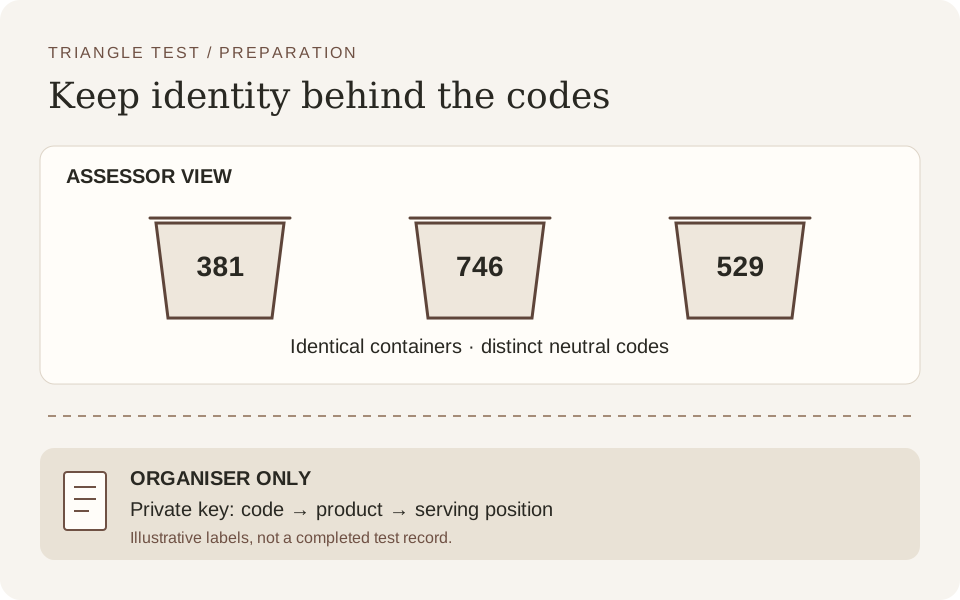
Codes conceal identity. The preparation key stays with the organiser; this diagram contains no responses or results.
Set the question before preparing samples
Write down the product pair and the change being investigated, such as an ingredient or process change. Identify the lots and the assessor population to which the planned conclusion will apply. This is a public-method planning guide from The Censes, an independent sensory publication; it reports no panel run by the site.
The ISO 4120:2021 public abstract describes a forced-choice method applicable to homogeneous products. It limits the method’s use with strong carryover or lingering flavours. It also states that the method does not determine the size or direction of a difference, or identify the attributes responsible. These are limits from the public abstract; this guide does not claim that the full standard was followed.
Rule of thumb: if the question is liking or acceptance, a triangle discrimination result does not answer it. The Society of Sensory Professionals’ publication guidance requires a consumer test for liking or acceptance and distinguishes discrimination from affective preference methods. The interpretation here follows that separation: detecting a difference cannot establish that consumers prefer it.
Prepare the coded set and conceal the key
In the Australian Wine Research Institute’s wine triangle method, each set contains three samples: two of the same wine and one of the other wine. The duplicate wine receives different codes. The taster selects the odd sample.
Use the preparation record to connect each code to its product and serving position. Keep that record away from assessors. A/B labels describe product identity in an organiser’s plan; they are not the labels on the assessor’s containers.
For food and drink, Campden BRI’s procedure describes consistent preparation, identical containers and three-digit codes under controlled conditions. Its account concerns Campden’s testing practice; it does not describe facilities or capabilities operated by The Censes.
Allocate order and record presentation conditions
AWRI lists six possible orders for its wine triangle sets: AAB, ABA, BAA, BBA, BAB, ABB. Record the allocated order privately and randomise presentation across tasters. The order diagram shows the wine alternatives, not a panel allocation or a required number of assessors.
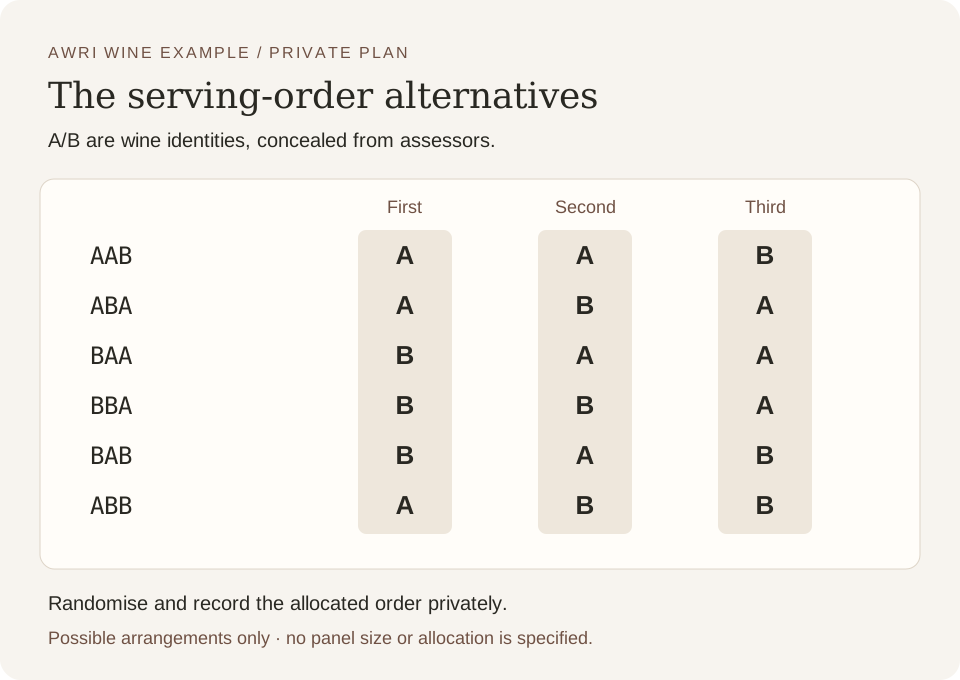
Wine example from AWRI. Each row is a possible arrangement; A/B identities remain concealed during assessment.
For wine, AWRI’s practical considerations recommend equal 30 mL pours at about 20°C in covered glasses. Those values belong to the wine example. A different product needs its own justified serving quantity, temperature, holding conditions and suitable palate-cleansing arrangements.
Record the actual preparation and presentation conditions, including deviations. Controls cannot make the method suitable for a product with strong carryover simply by being listed on a form. Review that suitability before execution. For the broader planning checklist, see sensory test design.
Collect an independent forced-choice response
Campden’s described procedure asks assessors to evaluate from left to right and select the different sample, even if they perceive no difference. A comment can record that the choice was a guess. Adding a “no difference” response option would change that forced-choice task.
AWRI advises that tasters should not communicate until they have written their judgment. Record the selected code before discussion. Comments can preserve what an assessor noticed, but they do not by themselves measure an attribute or identify the cause of a difference.
The following comparison connects common mistakes to the controls described above. It is a planning aid, not an experimental result.
| Protocol choice | Dominant Failure Mode | Prevention |
|---|---|---|
| Hidden identity versus recognisable labels | Product expectations influence the choice. | Use distinct neutral codes, including for duplicate samples, and keep the key private. |
| Allocated order versus one fixed sequence | Position becomes entangled with product identity. | Plan and record serving orders; randomise presentation rather than assigning everyone one convenient sequence. |
| Consistent presentation versus uneven preparation | Container, temperature or handling differences become unintended cues. | Standardise preparation and containers; record actual conditions and deviations. |
| Written independent choice versus group discussion | Assessors influence one another before recording a response. | Collect written selections before communication. |
| Planned analysis versus reading a majority as proof | Guesses or dependent repeat judgments are overinterpreted. | Specify the analysis and decision rule before execution, including treatment of repeats. |
| Discrimination versus preference | A detectable change becomes an unsupported liking claim. | Use a separate consumer study when the decision concerns liking or acceptance. |
Specify analysis before execution
Campden describes counting correct choices and assessing them against statistical tables. Selecting a code is therefore not sufficient evidence of discrimination, and a simple majority is not a decision rule supplied by this guide.
No correct-response cutoff is computed here because the public packet does not supply one for the proposed test. Panel size, alpha, power, repeat structure and the treatment of repeat judgments remain design inputs. They must be specified with an appropriate analysis reference before execution. Repeated responses must not automatically be counted as independent new assessors.
Report only what the design supports
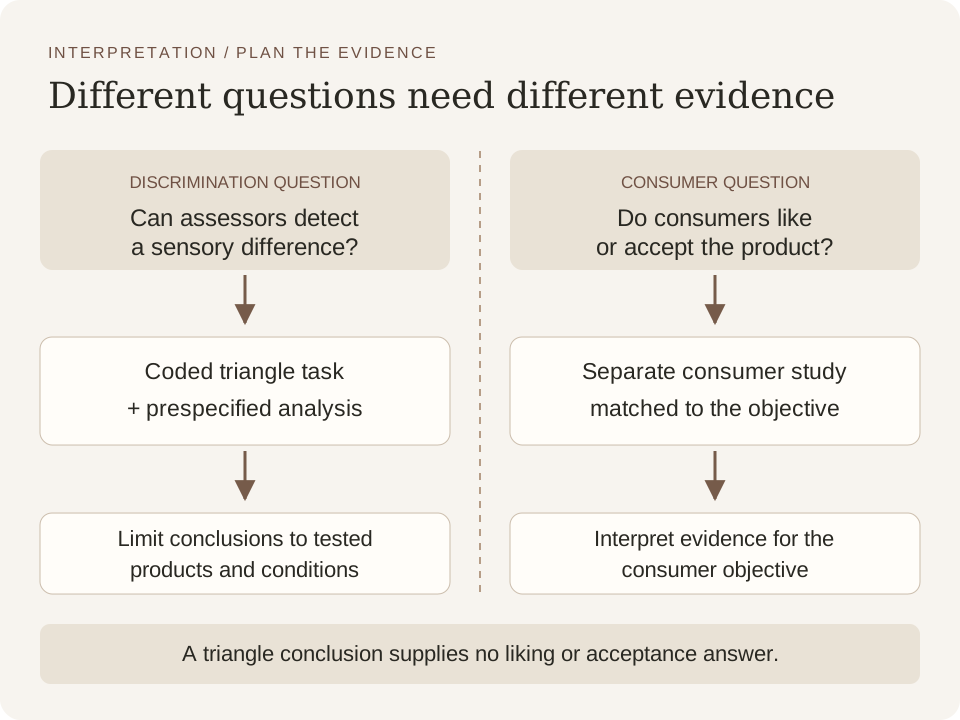
The paths describe which evidence to collect. They contain no observed outcome or numerical decision threshold.
A supported discrimination conclusion is limited to the tested products, assessors and conditions. It gives neither a preference winner nor an acceptance forecast. Failure to establish a difference also should not be relabelled product identity or formal equivalence; the necessary similarity design and acceptance criterion are not supplied here.
Keep a record of the objective, product and lot identities, private code key, serving orders, actual conditions, assessor suitability, selected codes, guess comments, response times and any repeat identifiers. Attach the prespecified analysis reference and decision rule, then state the conclusion within their limits. This record list is an editorial planning aid, not a validated scoresheet. If the next decision concerns liking, collect the consumer evidence that decision requires.