
Treating a sniff as the whole aroma of eating loses what happens when food is broken down in the mouth and its volatile compounds travel toward the nose. Orthonasal olfaction samples odors arriving from outside through the nostrils; retronasal olfaction samples odors transported from the mouth toward the back of the nose during eating. Aroma release is another part of the explanation: compounds must leave the food before they can be carried in air and perceived.
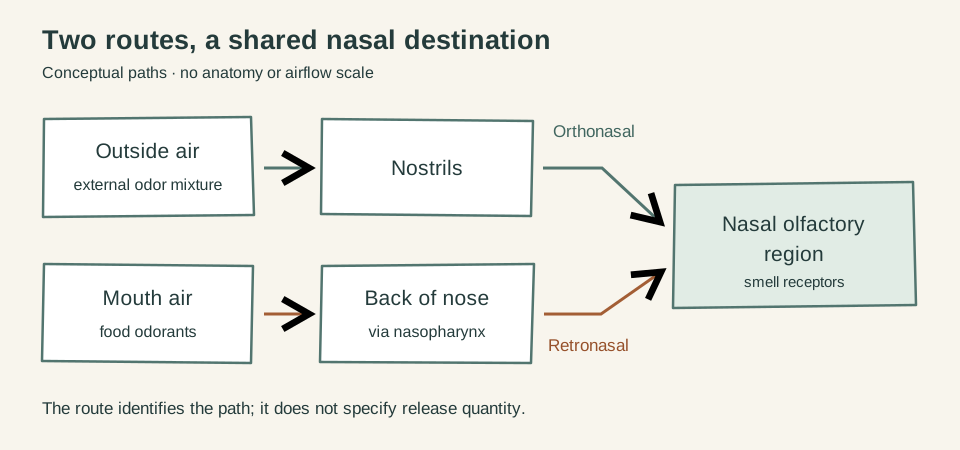
Two routes to the olfactory region
An external sniff is an orthonasal observation. Retronasal olfaction occurs as odors move from the oral cavity toward the nose during chewing and swallowing. Both are routes for smell, with the olfactory receptor region in the nose as their destination. The mouth is the starting point of retronasal transport, rather than a separate smelling organ. Spence’s review describes this distinction.
For the broader separation of these senses, see taste and smell. Here, the useful question is what each observation establishes about the food’s aroma.
Rule of thumb: if the observation is an external sniff, it does not establish the aroma released while the food is chewed and swallowed.
Release, transport and perception answer different questions
Release concerns volatile compounds leaving the food and entering mouth air. Transport concerns their delivery toward the nasal olfactory region through swallowing and breathing. Perception concerns the aroma experienced. Naming a route does not specify the amount released, the delivery over time or the perceived intensity.
Food structure and oral processing affect release. Chewing, saliva and food breakdown therefore belong in an explanation of aroma during eating. The review by Le Quéré and Schoumacker distinguishes dynamic measurements of compounds in exhaled air from sensory methods that follow perception over time.
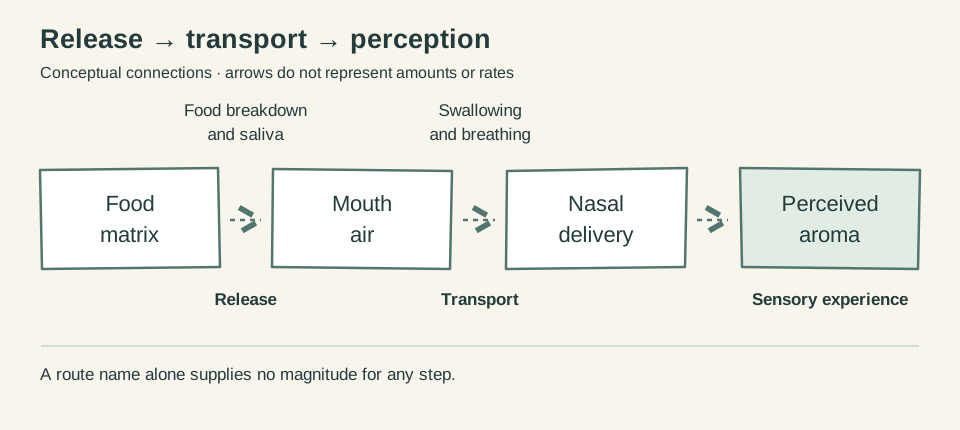
The following comparison organizes those distinctions; it is not a validated test protocol.
| Observation or method | What it addresses | Dominant Failure Mode | Prevention |
|---|---|---|---|
| External sniff of food | Orthonasal perception of the airborne mixture available under that sampling condition | Treating sniff strength as the complete eating aroma | Record the sampling condition and identify the route explicitly. |
| Aroma experienced while eating | Retronasal olfaction within the wider flavor experience | Calling every mouth sensation smell or attributing every difference to route | Keep aroma observations separate from taste, texture and chemesthesis. |
| Instrumental sampling of exhaled-air compounds during eating | Chemical delivery over time under a defined protocol | Treating detector signal as perceived aroma intensity | Pair chemical measurements with appropriate sensory observations. |
A mayonnaise experiment shows why the distinction matters
In van Eck and colleagues’ experiment, mayonnaises contained the lemon odorants limonene and citral. Researchers measured in-nose aroma release and simultaneous perceived lemon intensity, testing the mayonnaises alone and with bread or potato carriers.
Within these studied lemon-flavored mayonnaises, increasing viscosity or decreasing fat content reduced lemon aroma release and simultaneous lemon intensity. When bread or potato was added to the tested mayonnaises, lemon aroma release increased while simultaneous perceived lemon intensity decreased, compared with mayonnaise alone. The carrier condition is essential to that result.
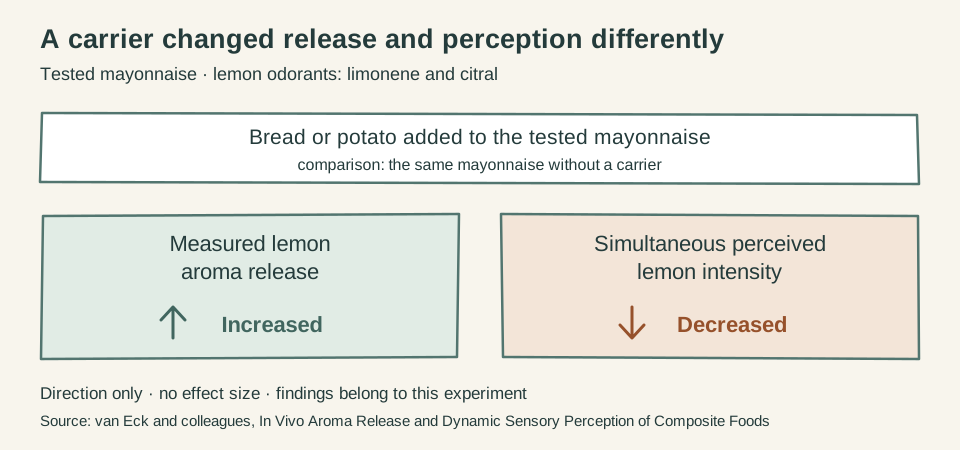
This experiment demonstrates that release and perceived intensity can move in opposite directions in a particular food context. It does not establish that release never predicts perception. Nor does its fat result establish a rule for other foods: the dynamic-methods review describes faster, more intense aroma delivery with less measured persistence in low-fat flavored yogurts, alongside compound-dependent and texture-dependent findings.
What an external sniff leaves unresolved
A recognizable mixture is not a molecular inventory. Cho and Peterson’s review explains that recognizing characteristics of a whole odor mixture does not identify all its individual odorants, and that mixture perception is not simply the sum of isolated odor qualities. Recognizing a familiar note therefore does not establish the mixture’s full chemical composition.
There is also a time limit. The dynamic-methods review explains that a static sensory observation does not capture the full temporal experience. The inference for an ordinary external sniff is that it is not, by itself, a calibrated measurement of the amount or time course released during chewing and swallowing.
No release quantity is computed here because the cited evidence provides no universal conversion from external sniff strength to aroma release during eating. A relevant measurement would need a defined food and consumption protocol, chemical sampling over time, and sensory observations suited to the perceptual question. Keeping those records distinct makes it possible to assess whether a difference concerns release, delivery or the aroma experienced.