
“Easy to open” is not a torque. The pages that print numbers are talking about rotational force on a screw cap, in inch-pounds, under conditions they name.
Write the cap size, which torque you measured, and when you measured it. Enercon and a Wolf Packing equipment page do not agree on the clock, and neither page is a test of how hard a person pulls.
This is the packaging note. A coffee pouch is a different closure, discussed on the valve page.
Two clocks, two percentages
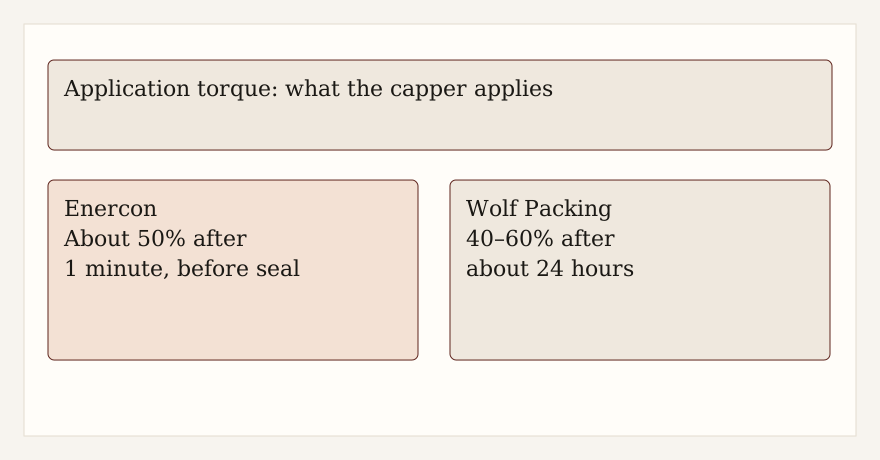
Enercon describes immediate removal torque as the reading after the bottle relaxes for one minute after capping and before induction sealing. It says that reading should be about 50 percent of application torque. Its worked example is a 38 mm closure applied at 18 inch-pounds, with immediate removal torque of approximately 9 inch-pounds. After induction sealing, it says removal torque is likely a bit lower, and that the amount varies with the heat-induction seal material. It mentions child-resistant closures as a case where a line might add torque again after sealing so the closure still meets the torque that feature requires. It does not print that required value.
Wolf Packing says removal torque is what it takes to open the container later, typically measured 24 hours after capping, and that removal torque normally reads 40 to 60 percent of application torque. The drop is attributed there to gasket compression, material creep and thermal relaxation. That 24-hour window is not Enercon’s one-minute window. The percentages should not be averaged into one rule.
A published cap-size band is a starting point
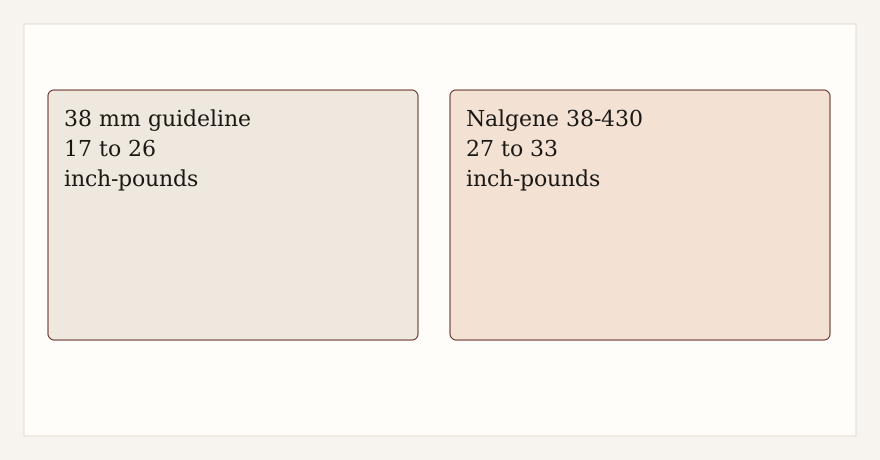
Enercon prints an application-torque guideline in inch-pounds. The 38 mm column is 17 to 26. The full band on that table is:
| Cap size (mm) | Application torque (inch-pounds) |
|---|---|
| 15 | 6 to 9 |
| 18 | 7 to 10 |
| 20 | 8 to 12 |
| 22 | 9 to 14 |
| 24 | 10 to 16 |
| 28 | 12 to 18 |
| 33 | 15 to 25 |
| 38 | 17 to 26 |
| 43 | 18 to 27 |
| 48 | 19 to 30 |
| 53 | 21 to 36 |
Wolf Packing cites the same sort of 38 mm band, 17 to 26 inch-pounds, and then a different figure: a Nalgene 38-430 cap specified at 27 to 33 inch-pounds. The page says general charts are starting points and that application torque should come from the cap manufacturer. It also says screw-cap torque does not apply to pre-made pouches, which use heat or pressure sealing.
What to write down
| Field | Why it is on the note |
|---|---|
| Closure and finish | 38 mm is not the same spec as 38-430 |
| Application torque and unit | The pages use inch-pounds |
| Removal torque and the clock | One minute before sealing is not 24 hours later |
| Whether an induction seal was already applied | Enercon says the liner height changes when it is heated |
| Whose number it is | A guideline table is not a reading from one line |
Nothing on either page measures the force in a hand, a peel tab, or a pouch. Calling a pack usable still needs a person and a method, which these pages do not supply. If the question is whether people can tell two samples apart at all, start with the sensory checklist and do not paste these inch-pounds into it.