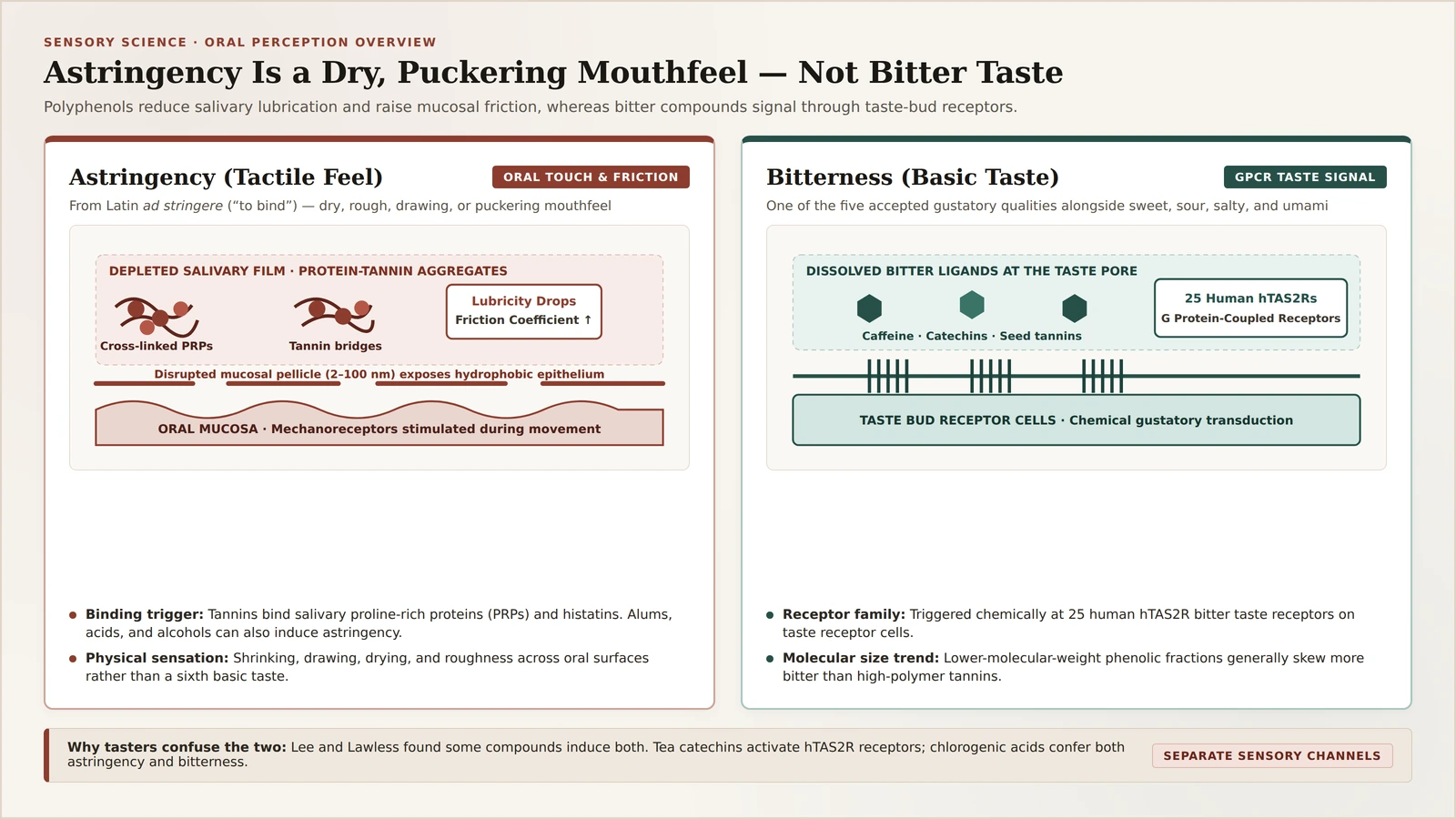
Astringency is the dry, rough, drawing, or puckering mouthfeel produced when tannins and related compounds bind salivary proteins, impair natural oral lubrication, and raise friction between mucosal surfaces. Unlike bitterness—which is one of the five accepted gustatory qualities transduced chemically through 25 human hTAS2R G protein-coupled taste receptors—astringency is understood primarily as a tactile component of flavor felt across oral tissues, especially when the tongue and cheeks move.
Because certain plant phenolics trigger bitter receptors and deplete salivary lubricity in the same sip, tasters can mistake oral dryness for bitter taste and adjust extraction or formulation in the wrong direction. Within sensory science, separating touch-driven mouthfeel from taste complements how smell and taste differ and sits beside the perceptual context covered in texture and expectation.
| Oral Dimension | Astringency | Bitterness |
|---|---|---|
| Primary sensory channel | Tactile sensation across oral surfaces driven by loss of saliva lubricity and higher mucosal friction | Gustatory taste quality among the five accepted tastes (sweet, sour, salty, bitter, and umami) |
| Core molecular event | Tannins bind salivary proline-rich proteins (PRPs) and histatins; alums, acids, and alcohols can also induce astringency; Green ties lost lubrication to precipitation of salivary mucoproteins | Dissolved bitter ligands bind 25 human hTAS2R G protein-coupled receptors on taste buds |
| Characteristic oral feel | Shrinking, drawing, tightening, drying, and roughness across the epithelium and buccal musculature, mainly when the mouth moves | Gustatory quality among sweet, sour, salty, bitter, and umami, carried by hTAS2R receptors |
| Polyphenol size tendency | Tannins with higher mean degree of polymerization (mDP), molecular weight, and galloylation interact more strongly with proteins | Lower-molecular-weight phenolic fractions, such as smaller grape seed tannins (DP 2 to 17), tend to be more bitter |
What Does Astringent Mean When Tasting Food or Drink?
The word astringency comes from the Latin ad stringere (also written adstringere), meaning “to bind,” as reviewed by Pires and colleagues in Foods (2020) and Soares and colleagues in Molecules (2020). Bate-Smith and colleagues argued that astringency is a feeling rather than an additional taste alongside the five accepted gustatory sensations—sweet, sour, salty, bitter, and umami—and it is understood as a tactile sensation resulting from the mechanical effect of decreased salivary lubrication.
Standardized sensory and psychophysical definitions emphasize physical contraction and drag across the mouth:
- ASTM definition: As quoted in the Foods (2020) review, the American Society for Testing and Materials defines astringency as “the complex of sensations due to shrinking, drawing or puckering of the epithelium as a result of exposure to substances such as alums or tannins.”
- Movement-dependent roughness: Lawless and Corrigan described tightening and drawing in the buccal musculature paired with drying and roughness during oral contact and movement. Experimental validation cited by Pires and colleagues confirmed that astringency is tactilely perceptible on all oral surfaces—more so when oral movement occurs than at rest—and that a higher friction coefficient relates linearly to stronger astringency ratings.
- Everyday tasting examples: Pires and colleagues list red wine, tea, chocolate, fruits, and nuts as astringent foods, and Green names fruits, nuts, teas, and coffee among foods and drinks whose mouth-surface texture change is part of flavor. In a 20 September 2016 Beer and Brewing off-flavor column, Dave Carpenter illustrated the sensation through drinking young red wine, sucking on a tea bag, or eating a piece of under-ripe fruit—calling that dry, puckery, thirst-inducing parched feeling tannic after the plant polyphenol tannins that provoke it.
What Happens in Saliva When a Drink Feels Astringent?
When a beverage feels astringent, the sensation can be induced by the binding of tannins, alums, acids, or alcohols. Green (1993) ties that sensation to precipitation of salivary mucoproteins and to higher friction between mucosal surfaces, while Peyrot des Gachons and colleagues (2012) describe dry, rough sensations that come in part from breaking down mucinous lubricating proteins in saliva.
Pires and colleagues (2020) describe human saliva as approximately 98% water alongside electrolytes and proteins including proline-rich proteins (PRPs), statherin, P-B peptide, cystatins, mucins, and histatins. Across two separate reviews, salivary protein shares are reported against different denominators that should be kept distinct:
- Share of total salivary protein (Foods, 2020; Molecules, 2011): Pires and colleagues report that PRPs make up around 70% of total salivary proteins, providing oral lubrication and preventing bacterial agglutination, with 6–9 kDa basic PRPs showing verified anti-viral activity and high tannin-binding affinity. In McRae and Kennedy’s Molecules (2011) review, histidine-rich proteins (histatins or HRPs) are also major tannin-binding proteins while constituting 2.6% of salivary protein.
- Sub-classes within the PRP pool itself (Molecules, 2011): Looking specifically inside parotid and known PRPs—intrinsically unfolded proteins with tandem repeats and polyproline (PPII) helices offering numerous tannin-binding sites—McRae and Kennedy report basic PRPs at around 23% of PRPs in human parotid saliva (binding dietary tannin so it does not inhibit stomach digestive enzymes), acidic PRPs at around 30% of known PRPs (binding calcium as part of the dental pellicle), and glycosylated PRPs at 17% of known PRPs (supporting oral lubrication and antibacterial activity).
Model studies summarized by McRae and Kennedy (2011) and Pires and colleagues (2020) divide polyphenol-protein binding into three stages, followed by mucosal pellicle disruption:
- Stage 1 (reversible binding): Tannins bind unfolded salivary proteins through hydrophobic interactions and hydrogen bonding; interaction strength generally rises with higher polymerization degree, molecular weight, and galloylation degree, though exact behavior depends on the specific tannin–protein pair.
- Stage 2 (cross-linked aggregates): Protein-tannin complexes self-associate via polyphenol bridges and protein dimers. Crucially, precipitation is not strictly required: McRae and Kennedy note that soluble aggregates formed between hydrolysable tannins and gelatin in vitro still produced astringency in vivo, and tannin complexes with glycosylated PRPs remain soluble whereas non-glycosylated PRP complexes are more likely to precipitate (though the exact sensory impact of that solubility split remains unknown).
- Stage 3 (colloidal precipitation and pellicle breakage): Aggregated complexes coalesce into colloidal particles that precipitate and can adhere to oral mucosa as a sticky residue. Meanwhile, saliva coats the mouth in two layers: a dynamic removable layer and a covalently attached epithelial pellicle roughly 2 to 100 nm thick. Disrupting that pellicle exposes epithelial cells and receptors, increases surface hydrophobicity to a water contact angle of 71°, and raises mucosal friction, while tissue-protein precipitation has also been linked to water loss, reduced tissue permeability, and epithelial shrinkage.
Individual saliva differences shift the threshold as well: McRae and Kennedy report that higher concentrations of particular salivary proteins and a higher salivary flow rate generally reduce perceived astringency.
What Is the Difference Between Astringency and Bitterness?
Bitterness is a receptor-mediated chemical taste, whereas astringency is predominantly a mechanical, tribological mouthfeel—even though overlapping phenolic chemistry allows a single sip to evoke both.
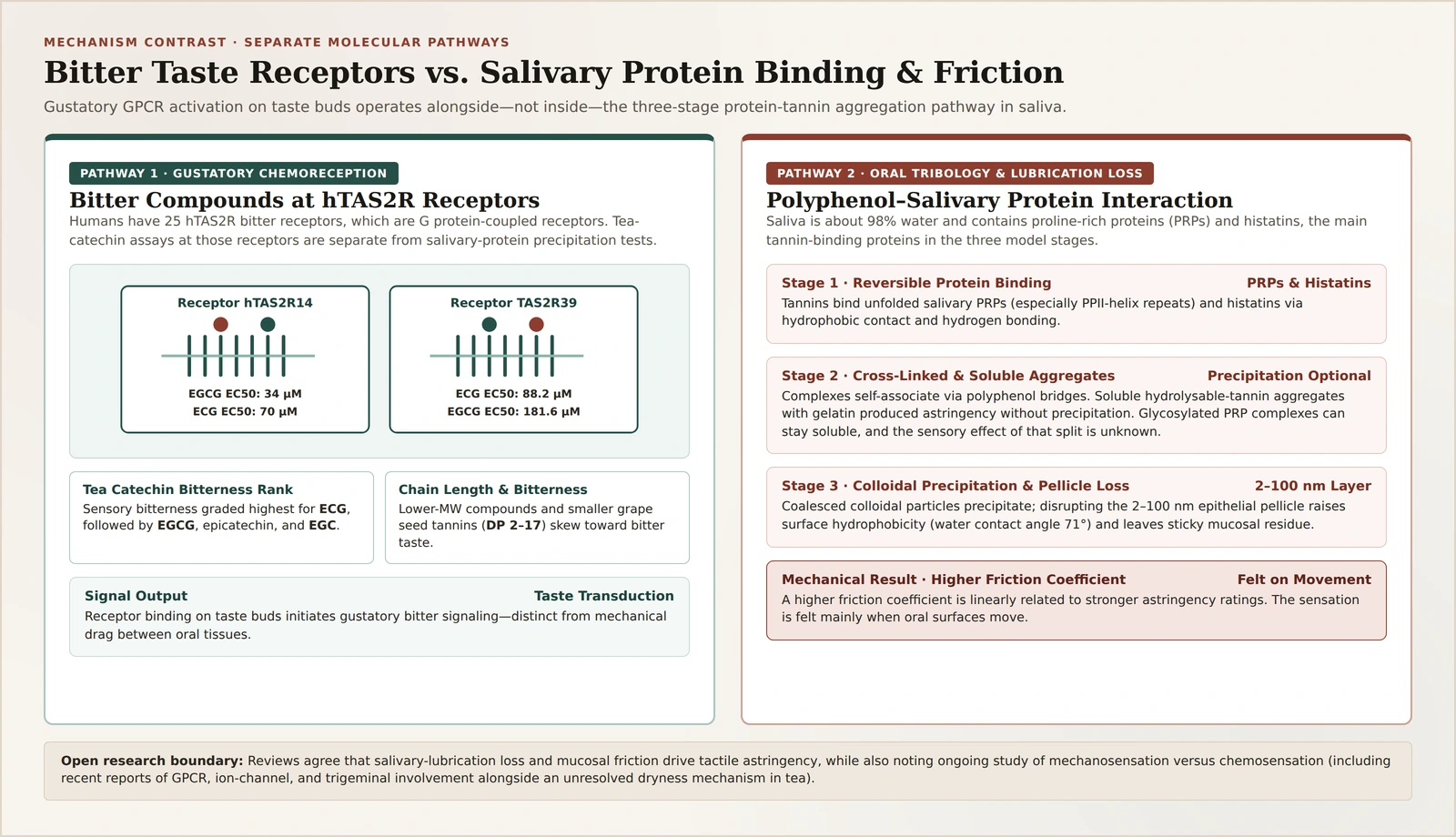
As detailed by Soares and colleagues (2020), humans possess 25 hTAS2R bitter taste receptors belonging to the G protein-coupled receptor (GPCR) superfamily. Tea flavanols illustrate how specific molecules engage those bitter receptors directly: sensory grading found bitter taste perceived more strongly for epicatechin gallate (ECG), followed by (−)-epigallocatechingallate (EGCG), epicatechin, and epigallocatechin (EGC). In receptor assays reported in the same review, EGCG and ECG activated hTAS2R14 with EC50 values of 34 µM and 70 µM, respectively, and activated TAS2R39 with EC50 values of 181.6 µM and 88.2 µM, respectively.
Across wider tannin families, Soares and colleagues highlight a consistent structural split: compounds with a lower molecular weight tend to be more bitter, whereas tannins with a higher mean degree of polymerization (mDP)—such as procyanidin oligomers—tend to be more astringent.
At the same time, peer-reviewed reviews preserve an open mechanistic question rather than treating oral friction as the sole biological event in every study:
- Pires and colleagues (2020) note ongoing debate over whether astringent compounds act through mechanosensation, chemosensation, or a combination of both, listing mechanoreceptor and chemoreceptor perception alongside pellicle breakage and lubrication loss.
- Green (1993) argued that astringency arises primarily from increased friction between mucosal surfaces despite animal chorda-tympani nerve findings that had suggested a taste component.
- McRae and Kennedy (2011) observe that exact mechanisms are not fully understood and list increased friction, epithelial protein binding, saliva viscosity shifts, and bitter-receptor interactions from small condensed tannins as contributing factors.
- Liu, Tzen, and Wu (2022) state both that the exact mechanism for the feeling of dryness and puckering in the mouth remains unknown and that some recent evidence pointed to GPCRs and ion channels on taste buds with signals transported by the trigeminal nerve.
How Do Astringency and Bitterness Differ Over Time?
Evaluating a drink only during the first second on the tongue misses how astringency builds and lingers. Published studies track timing and multi-sip carry-over through several distinct experimental designs that should not be collapsed into a single number:
- 120-second intensity tracking: Pires and colleagues (2020) summarize a study comparing caffeine (bitter), quinine (astringent), and wine (astringent) for up to 120 seconds; both bitterness and astringency developed slowly with lingering aftertastes, while compounds recognized as astringent elicited distinct bitterness and astringency time-courses.
- 15-second development and 5-minute persistence: Elsewhere in the same Foods review, astringency is described as needing about 15 seconds to develop fully and extending for far longer—about 5 minutes.
- Cumulative build across sips: Green (1993) noted that dryness and roughness, even when subtle at first, can grow in magnitude over repeated exposures. Peyrot des Gachons and colleagues (2012) demonstrated that weakly astringent stimuli can produce strong sensations after repeated sampling, building with exposures toward an asymptotic level governed by compound structure and concentration.
- Sweetness and viscosity buffering: Pires and colleagues also cite studies in which adding sucrose—or raising soymilk viscosity with carboxymethyl cellulose—reduced both astringency intensity and its rate of increase across repeated sips.
When planning formal evaluations where carry-over can skew scores, panel attribute definitions, reference standards, and scale calibration belong to descriptive sensory analysis panels.
Why Does Red Wine Feel Dry and Astringent?
Red wine is a classic condensed-tannin matrix where grape tissue origin separates drying structure from bitterness. McRae and Kennedy (2011) contrast the two main grape tannin pools:
- Grape skin tannins: Composed of procyanidins and prodelphinidins in long polymeric chains ranging from DP 3 to 83 flavanol subunits, skin tannins drive protein binding and tactile mouthfeel.
- Grape seed tannins: Reported at smaller chain lengths between DP 2 and 17, seed tannins have a lower molecular weight that may account for their reported bitterness and may explain why seed tannins are considered undesirable in wine.
Alcohol modifies those sensations without following a single one-way rule across all studies. Ethanol in red wine ranges from approximately 11% to 15%: McRae and Kennedy note that higher ethanol concentrations decreased perceived astringency in model wines and altered wine astringency sub-qualities, although one cited report indicated an increase in astringency as ethanol rose.
Is Brewed Tea Supposed to Feel Astringent?
Phenolic compounds occur abundantly in tea, making a degree of astringency an expected tactile feature of brewed infusions rather than an automatic defect—and tea phenolics even split into distinct astringent sub-qualities. Liu, Tzen, and Wu (2022) report that flavan-3-ols such as catechins trigger puckering astringency, whereas flavonol glycosides such as rutin induce velvety astringency (forming a smooth surface on complexed artificial oil bodies).
To rank individual catechins, Liu, Tzen, and Wu prepared eight 2 mM tea catechin standards in distilled water and reacted them in an in vitro artificial-oil-body assay employing a single human salivary peptide, histatin 3:
- Catechin astringency order: Gallate-type catechins were more astringent than non-gallate-type catechins, following the exact sequence: epicatechin gallate (ECG) > epigallocatechin gallate (EGCG) > gallocatechin gallate (GCG) > catechin gallate (CG) > epigallocatechin (EGC) > epicatechin (EC) > gallocatechin (GC) > catechin.
- Laboratory steeping kinetics (assay protocol, not a home recipe): In a controlled laboratory test that added 3 g of oolong tea leaves to 150 mL of boiling water and held them in a 70 °C water bath, with infusions compared at 10, 20, 30, and 40 minutes, the rise from 10 to 40 minutes was higher for gallate-type catechins EGCG and ECG (107% and 145%) than for non-gallate catechins EGC and EC (77% and 65%), and the paper reports that tea astringency was elevated exponentially rather than proportionally.
- Assay boundary: Because the model uses only histatin 3 rather than whole human saliva, the authors note that the in vitro assay is practicable for assisting sensory evaluation of tea infusions rather than replacing human tasters.
What Causes Astringency vs. Bitterness in Coffee?
Coffee contains phenolic acids that contribute to both tactile dryness and bitter taste, yet roasting shifts bitterness specifically in the published chemistry literature. In their minireview Phenolic compounds in coffee (2006), Adriana Farah and Carmen Marino Donangelo state two distinct findings:
- Chlorogenic acids (CGA) in the cup: CGA are major determinants of coffee flavor that contribute to final acidity and confer both astringency and bitterness to the beverage.
- Roasting transformation: Bitterness increases during roasting due to the release of caffeic acid and the formation of lactones and other phenol derivatives responsible for flavor and aroma (citing Ginz and Enhelhardt, 1995; Maria et al., 1994; and Variyar et al., 2003).
Because the coffee chemistry review links roasting progression to rising bitterness through caffeic acid, lactones, and phenol derivatives—while attributing beverage astringency and bitterness together to chlorogenic acids—tasting notes should separate dry, rough tongue drag from roast-driven bitter taste before changing roast or formulation targets.
Which Fruits Commonly Produce an Astringent Mouthfeel?
Phenolic tannins occur abundantly in unripe fruits, preventing astringent fruit from being eaten until ripening reduces soluble tannin activity. University of Florida extension publications MG242, HS1483, and HS1493 highlight unripened bananas, unripe persimmons, and acorns as classic examples where astringency dominates palatability.
Persimmon physiology shows clearly why solubility—not total tannin presence alone—controls oral drying:
- Cellular release on chewing: Astringent persimmon flesh stores concentrated condensed tannins (proanthocyanidins, specifically water-soluble kaki-tannin) inside the vacuoles of specialized tannin cells. When chewing bursts those cells, water-soluble tannin adsorbs to proteins on the tongue and binds saliva proteins, creating a sensation of dehydration that dries and puckers the mouth, numbs the tongue, constricts the throat, and may sometimes also impart a bitter taste. (Horticultural guides colloquially call this an “astringent taste,” whereas oral-physiology reviews classify the drying, puckering effect as tactile mouthfeel.)
- Natural ripening and postharvest deastringency: As astringent persimmon varieties ripen, soluble tannins polymerize—chemically combining into larger insoluble molecules—until astringency disappears in fully ripe fruit. Postharvest treatments achieve the same polymerization deliberately: Pires and colleagues (2020) note that exposing persimmons to high CO2 concentrations of 95–98% promotes anaerobic respiration that renders tannins insoluble and eliminates detectable astringency, with post-treatment testing used to check for residual astringency.
Tasting Comparison Card: Dry Mouthfeel vs. Bitter Cue
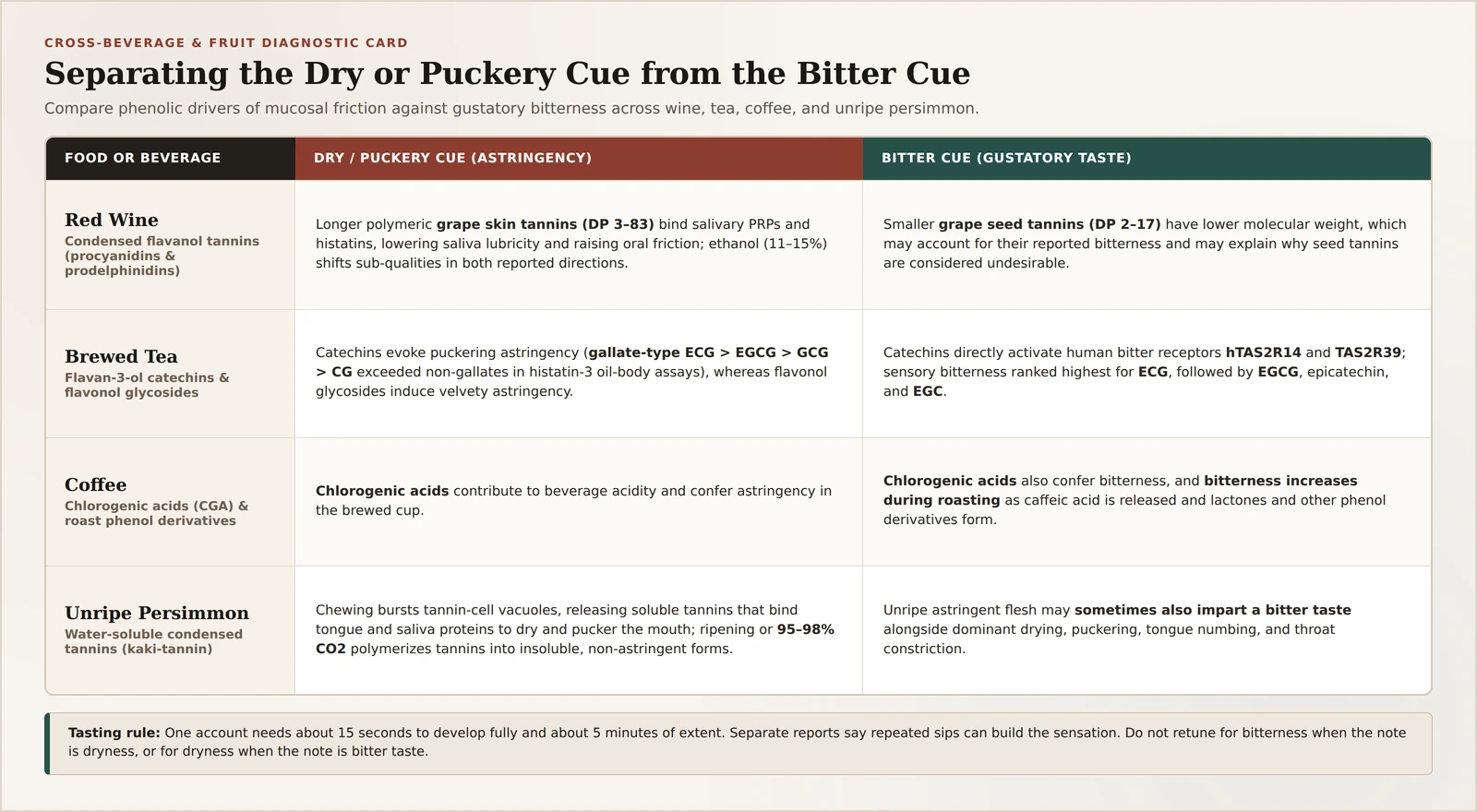
Use the English comparison record below during beverage or fruit evaluation to separate mucosal friction from bitter taste before changing an ingredient, harvest stage, or process variable:
| Matrix | Primary Phenolic Drivers | Dry or Puckery Cue (Astringency) | Bitter Cue (Gustatory Taste) | Practical Evaluation Check |
|---|---|---|---|---|
| Red wine | Condensed tannins (procyanidins and prodelphinidins) | Longer grape skin tannins (DP 3 to 83) bind salivary PRPs and histatins, lowering saliva lubricity and raising oral friction; 11% to 15% ethanol shifts sub-qualities in both reported directions | Smaller grape seed tannins (DP 2 to 17) carry lower molecular weight linked to reported bitterness | Separate the dry mouthfeel of longer skin tannins from the bitter taste linked to smaller seed tannins |
| Brewed tea | Flavan-3-ol catechins and flavonol glycosides | Catechins trigger puckering astringency (gallate-type ECG > EGCG > GCG > CG outranked non-gallates in histatin-3 oil-body assays), whereas flavonol glycosides give velvety astringency | Catechins activate bitter receptors hTAS2R14 and TAS2R39; sensory bitterness graded highest for ECG, then EGCG, epicatechin, and EGC | Distinguish puckering or velvety tongue friction from receptor bitterness |
| Coffee | Chlorogenic acids (CGA), caffeic acid, lactones, and phenol derivatives | Chlorogenic acids confer astringency alongside acidity in the brewed beverage | Chlorogenic acids also confer bitterness, and bitterness increases during roasting via caffeic acid release and lactone and phenol-derivative formation | Do not treat the dry cue as the bitterness that increases during roasting, or that bitter taste as dryness |
| Unripe persimmon | Water-soluble condensed tannins (kaki-tannin) in tannin-cell vacuoles | Burst tannin cells release soluble tannins that bind saliva and tongue proteins, drying and puckering the mouth until ripening or 95–98% CO2 polymerizes them into insoluble forms | Unripe flesh may sometimes impart a bitter taste alongside dominant drying, puckering, tongue numbing, and throat constriction | Check whether tannins have polymerized to insoluble forms rather than masking dryness as bitterness |
| Multi-sip timing | Separate time-course accounts | One Foods account gives about 15 seconds to develop fully and about 5 minutes of extent; repeated exposures can build the sensation toward a level set by structure and concentration; sucrose, or soymilk viscosity raised with carboxymethyl cellulose, reduced intensity and the rate of increase | The Foods review’s 120-second comparison labeled caffeine bitter and quinine and wine astringent, and both perceptions developed slowly with lingering aftertastes; bitter taste itself is carried by hTAS2R receptors | Do not score only the first second, and do not retune for bitterness when the note is dryness or for dryness when the note is bitter taste |
Recording dryness and bitterness on separate lines keeps troubleshooting aligned with the underlying oral mechanism: do not retune a formulation or process for bitterness when the tasting note is mucosal dryness, and do not retune it for dryness when the note is gustatory bitter taste.