
An odor detection threshold estimates when assessors can distinguish an odor stimulus from its reference; an odor recognition threshold estimates when they can recognize its characteristic quality. Recognition generally requires a higher concentration under comparable conditions. The distinction starts with the question asked of the panel and the response that counts as success.
Choose detection when the decision is whether an odor difference can be noticed. Choose recognition when the decision is whether a defined odor character can be recognized. Keep the medium, reference, presentation and assessor group comparable when interpreting the two results. Forced choice describes how assessors respond; it does not, by itself, determine which endpoint is measured.
| Comparison | Detection threshold | Recognition threshold |
|---|---|---|
| Required perception | An odor difference from the reference | A recognizable odor quality |
| Endpoint question | Can the target be distinguished? | Can its characteristic quality be recognized? |
| Typical concentration relationship | Lower than recognition under comparable conditions | Higher than detection under comparable conditions |
| What the result supports | Sensitivity to a detectable difference | Sensitivity to a defined odor character |
These endpoint definitions follow ASTM E679-26. The general concentration relationship is described in the EPA’s 1992 odor-threshold reference guide, section 1.2.1.9. The relationship is a tendency under comparable conditions, rather than a fixed conversion between the two results.
What should the assessor be asked?
The prompt and the scoring rule must ask for the same endpoint. Choosing the target from a coded set establishes a detection response; recognizing its character requires an additional, defined judgment about odor quality.
Use the following question comparison when planning a panel. For recognition, agree on the target quality and accepted responses before testing. Recognition can concern a quality such as a defined descriptor; it does not require identifying the exact chemical molecule.
| Planning field | Detection | Recognition |
|---|---|---|
| Prompt for a forced-choice set | “Select the sample that differs from the other two. Choose even if uncertain.” | “Select the sample with the defined odor character and record that character.” |
| What counts as a successful response | Correct target selection, evaluated using the planned threshold-estimation rule | Target selection plus the recognition response specified by the protocol |
| Preparation of the assessor | Explain the selection task and reference comparison | Also establish the odor-quality vocabulary or reference and accepted responses |
| Response that needs careful interpretation | A single correct selection may be a guess | “It smells different” alone does not establish recognition of its character |
| Label on the report | Detection threshold | Recognition threshold |
These prompts illustrate the distinction within a forced-choice design. Adapt the wording and scoring together to the selected procedure. A recognition study may use another presentation format; the essential requirement is that its endpoint actually tests recognition.
How does a 3-AFC threshold series work?
A three-alternative forced-choice (3-AFC) comparison presents a target with two references and requires a selection. In an ascending concentration series, successive sets present more concentrated target samples. The choice within a set and the concentration progression across sets are separate parts of the design.
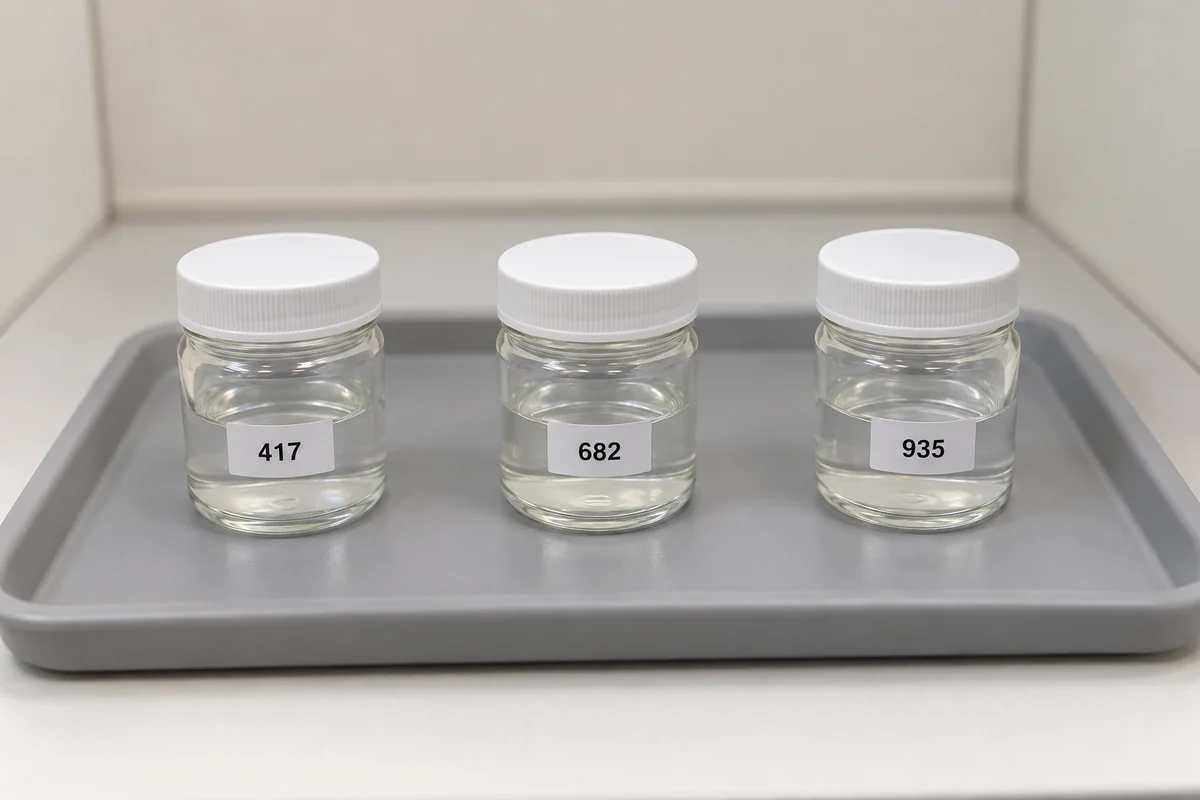
Keep the sample identity key with the preparation team. The assessor records a code, while the analysis uses the planned pattern of responses across presentations. A threshold is an estimate from that design, not simply the first correct answer in an informal sniffing exercise.
The standards address different scopes:
- ASTM E679-26 describes multiple forced-choice presentations in an ascending concentration series and covers detection or recognition endpoints.
- ISO 13301:2018 addresses detection using 3-AFC, including threshold estimation and error bounds. Recognition thresholds are outside that standard’s scope.
ISO also makes an important point about the reference: the procedure fundamentally measures a difference because it compares a test sample with a reference sample. A reference may have its own background odor. Specify what it contains instead of treating “blank” as a guarantee of absolute odorlessness.
Which conditions should the panel plan fix?
Fix the reference, presentation and response criterion before selecting the concentration series. A value measured in one medium or with one presentation method may not transfer to another. ASTM E679-26 also identifies assessor training as an influence on the result.

Build the plan around these controls:
- Medium and reference. Identify the target stimulus, the material carrying it and the reference composition. Keep preparation and handling comparable.
- Presentation. Specify containers, sample quantity, temperature, holding conditions and the route of assessment. Sniffing above a sample and perceiving aroma during eating involve different presentation conditions; see orthonasal and retronasal aroma release.
- Range and spacing. Use the selected method and a pilot to choose a concentration range that brackets the response transition. The spacing affects how closely that transition can be located.
- Assessors and repetition. Define the group, its training, the repeat structure and how responses will be combined. Preserve assessor and session identifiers in the data.
- Adaptation and carryover. Plan presentation order and recovery between exposures. Repeated smelling can change the response during a session, so manage it as part of the method.
The EPA guide discusses repetition, presentation order and adaptation in its review of gas-air threshold measurements. Apply the full procedure appropriate to the intended sample and endpoint when setting the operating details.
How do concentration and dilution-to-threshold differ?
For the same source sample, more dilution means a lower presented concentration. This reverses the numerical direction used to describe sensitivity: a lower threshold concentration can correspond to a higher dilution-to-threshold.
| Reporting basis | What the number describes | Typical detection-to-recognition direction |
|---|---|---|
| Concentration at threshold | How concentrated the presented stimulus is when the endpoint is reached | Recognition generally occurs at a higher concentration |
| Dilution-to-threshold | How far the same source sample is diluted when the endpoint is reached | Recognition generally occurs at a lower dilution |
Read “higher threshold” only after checking the basis. On a concentration scale, it means more stimulus is needed. On a dilution scale, a larger dilution-to-detection means the source can be diluted further while still meeting the detection criterion. The EPA guide describes ascending concentration as moving from greater to lesser dilution in section 1.2.1.10.
Keep the source sample, dilution definition and endpoint attached to the value. Comparing an air dilution result with a concentration measured in a liquid also requires accounting for the matrix and presentation; matching the word “threshold” is not enough.
Why does the endpoint matter in packaging odor screening?
If the screening question is whether a packaging-related odor difference can be detected, use a detection criterion. Record recognizable character separately when that information is needed. This is a practical consequence of the endpoint definitions.

Consider a screening brief that counts an odor only when assessors can describe its character. A sample that smells different but has no recognizable character would fail that recognition rule. It could still satisfy a detection rule. The scoring choice therefore changes which responses count, even before any product acceptance decision is made.
Prevent that mismatch by stating the decision in the brief: “detect a difference” or “recognize the specified character.” Keep any odor-character comments alongside the detection response rather than silently using them to redefine it. Consumer acceptance and packaging migration decisions need their own evidence and criteria; an odor threshold measures a sensory endpoint.
What should an odor threshold report contain?
Read the estimate together with its endpoint and test conditions. Use this checklist when requesting or comparing reports:
- Endpoint and task: detection or recognition, the assessor prompt and the accepted response.
- Sample and reference: stimulus identity, medium, reference composition and preparation.
- Result basis: units, concentration or dilution-to-threshold, and the definition of any dilution ratio.
- Presentation: assessment route, containers and controlled handling conditions.
- Panel and repeats: assessor group, training, session structure and treatment of repeated responses.
- Estimation: method and edition, concentration range and spacing, scoring/calculation rule and uncertainty where estimated.
For two reports, check those fields before deciding that one panel is more sensitive or one sample is more readily detected. An individual estimate, a panel summary and a recognition endpoint describe different things even if their numbers use the same units.
Begin the next test brief with the endpoint and accepted response, then choose the procedure that measures them. For the wider context, explore sensory science; if the assessment involves food or drink, the distinction between taste and smell helps define which sensory question to ask.