Descriptive sensory analysis generates quantitative data describing similarities and differences among products. Descriptor development produces a shared, unambiguous attribute and definition list. After the preliminary descriptor list, assessors train in intensity assessment and scale use.
Use this guide to work through the panel brief, from vocabulary to performance checks. Explore the wider product experience collection alongside it.
Build the lexicon around the product range
Lexicon development uses samples representing the product space as fully as possible. Lexicon terms must be non-hedonic, singular, and non-redundant. Choose your sample set and review the proposed vocabulary against those criteria. Screen potential panelists for sample discrimination, intensity rating, and taste and aroma identification.
From individual words to shared definitions
In the University of Arkansas chocolate-chip-cookie study, panelists independently proposed descriptors before refining them through consensus discussion. In that study, each term was defined and paired with reference standards to support consistency. The cookie panelists then trained to understand each attribute’s reference standards and definitions.
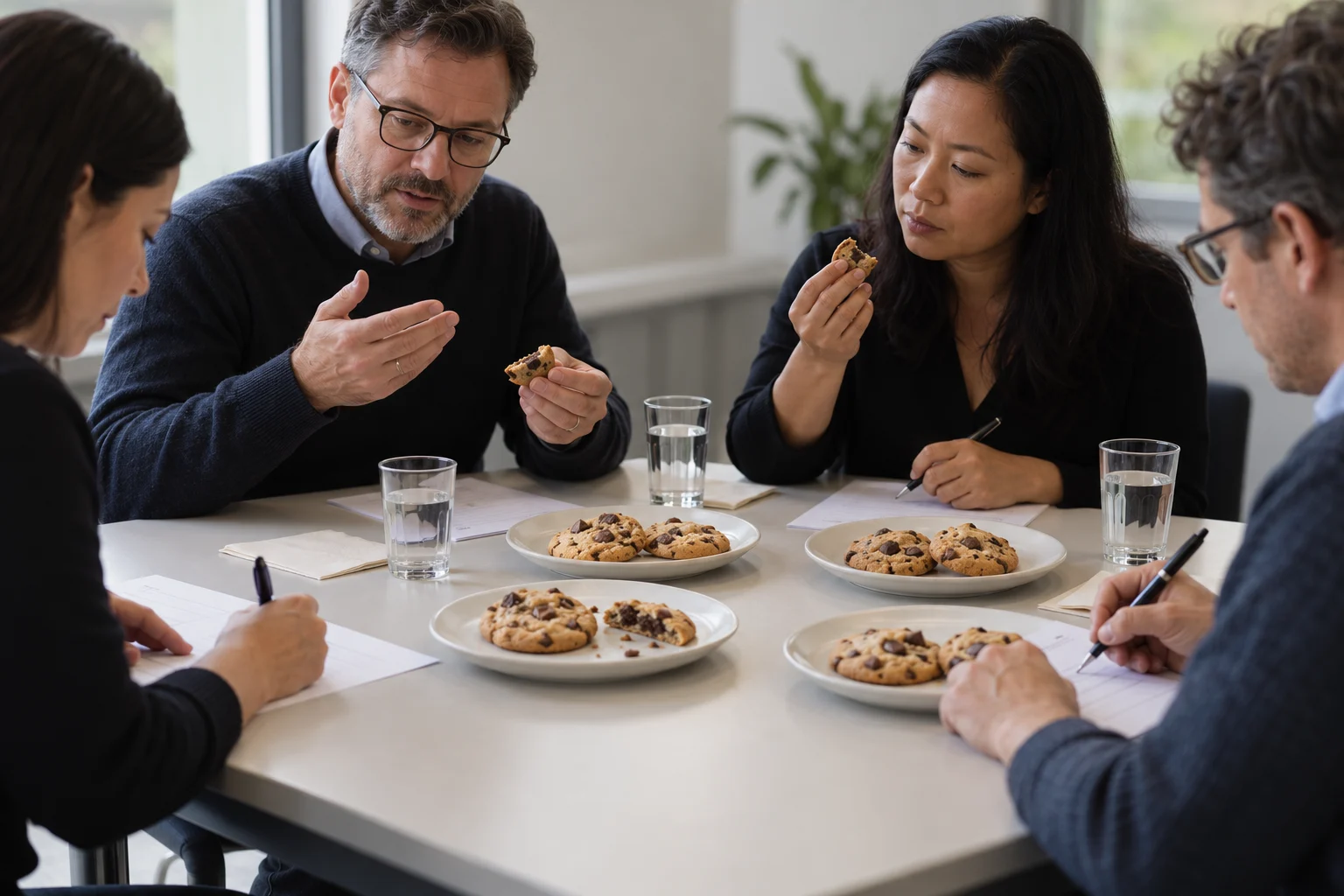
Developing the panel vocabulary.
Use this working record when assembling your lexicon. Fill it with your chosen category’s definitions and references.
| Record field | Prompt for the panel brief |
|---|---|
| Attribute and definition | What exactly does the term mean? |
| Sensory mode | Will you assess aroma, flavor, or both? |
| Reference identity | Which named reference will you use? |
| Preparation and serving | What instructions will you follow? |
| Intensity anchor | Does this reference have an assigned score? |
| Evaluation procedure | How will assessors evaluate the attribute? |
Reference standards: meaning, preparation and intensity
Consider the World Coffee Research sensory lexicon as a concrete category example. In the coffee lexicon, each attribute has a definition clarifying its name. Its references supply the standard against which an attribute is measured. Reference use in the coffee lexicon is designated for flavor, aroma, or both. Each coffee-lexicon reference includes preparation and serving instructions. Following the coffee lexicon’s reference preparation instructions preserves the intended intensity.
Hazelnut flavor reference example
The coffee lexicon’s hazelnut reference uses 1/8 teaspoon of McCormick Imitation Hazelnut Extract in 1 cup of milk for intensity 3.5. The second hazelnut reference uses 1/4 teaspoon in 1 cup milk for intensity 6.0.
Keep the named preparation and its assigned score together in your reference record.
The FlavorActiV 0920 sour reference has no assigned intensity score in this lexicon.
When reviewing an entry, ask separately about attribute recognition and the availability of an intensity anchor.
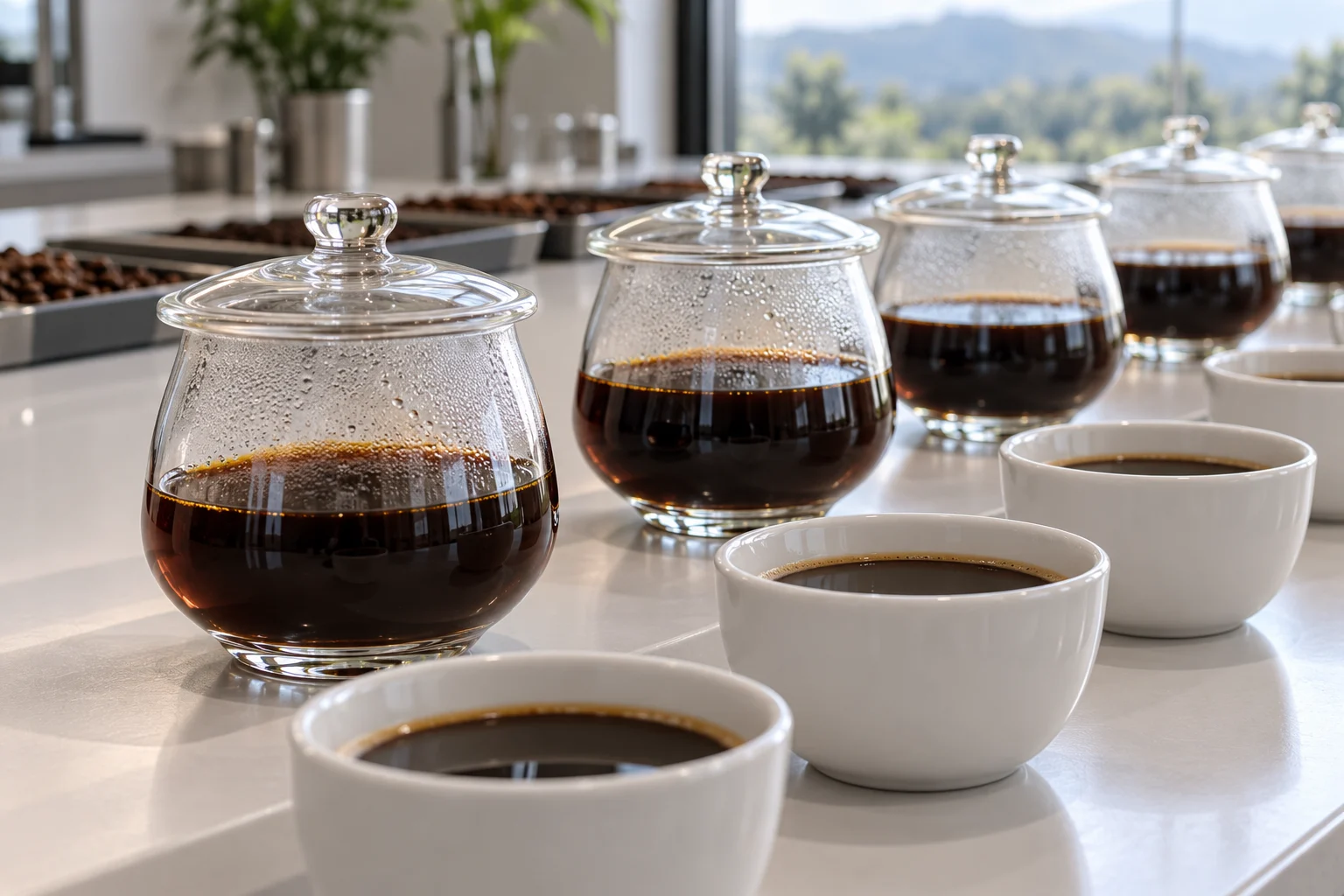
Preparing for aroma and flavor assessment.
The coffee lexicon prefers covered glass snifters for aroma references to prevent aromas contaminating one another.
Calibrate scale use after defining the attributes
ISO 4121:2003 describes quantitative response scales and their use in sample assessment. The cookie study used a 0–15 scale with 0.1-point increments. In the World Coffee Research lexicon, most references have assigned intensity scores on a scale of 1 to 15.
Record the chosen method and scale explicitly in your panel brief. Keep the cookie-study scale and coffee-reference scores in their respective contexts. For the relative-scaling training described in the DLG guide, reproducing one’s own ratings is more important than numerical matching between panelists.
Pilot the panel before routine profiling
A pilot phase familiarizes trained assessors with real test conditions through initial profile tests. The descriptor and definition list can be reduced during pilot measurement. Check panel performance against predefined minimum requirements before routine profiling.
Use the pilot review to finish your working lexicon and document the performance requirements for your study.
Keep formal sample evaluation explicit
In the coffee lexicon’s procedure, panelists smell aroma references and taste flavor references before comparing the coffee sample. In that procedure, panelists score each evaluated attribute’s intensity for each sample. Coffee sample evaluation in the lexicon’s procedure is usually silent.

Individual sample assessment.
In the cookie study, samples were presented in randomized sequential monadic order. Each of the 24 cookie samples received duplicate assessments.
Check discrimination, agreement and repeatability
Quantitative descriptive panel performance assessment covers the panel as a whole and each member. The performance criteria include product discrimination, agreement between assessors, and repeatability of intensity scoring. Performance assessment applies to training validation and monitoring established panels.
Review repeatability within the session
Repeatability concerns similar results and scale values for the same sample under identical conditions. Concealed duplicate samples from the same batch can be integrated into a session to review repeatability.
Review agreement and scale use
Panel consistency concerns comparability with other assessors or closeness to the panel mean. Zero scatter is not possible in practice. In PanelCheck, mean and standard-deviation plots help inspect differences in assessors’ scale use. In PanelCheck, the F plot provides information on discrimination ability. In PanelCheck, the MSE plot provides information on repeatability. If performance deviations occur, the panel leader must implement focused training or sensory exercises.
Finish the panel brief
Before proceeding, review your records against these questions:
- Which products will the lexicon cover?
- Are the attribute names and definitions agreed?
- Are the reference identity, sensory mode and preparation instructions recorded?
- Which references have assigned intensity scores?
- Which scale and evaluation procedure will assessors use?
- What will the pilot review examine?
- How will you review discrimination, agreement and repeatability?
For broader study planning, continue to our sensory test design guide.
Sources
- Society of Sensory Professionals — Descriptive Analysis.
- Foods — The Importance of Sensory Lexicons for Research and Development of Food Products.
- Foods / University of Arkansas researchers — Descriptive Sensory Analysis of Gluten-Containing and Gluten-Free Chocolate Chip Cookies Available in the Marketplace.
- World Coffee Research — Sensory Lexicon.
- DLG — Practice guide for sensory panel training: Training of sensory assessors.
- DLG — Practice guide for sensory panel training: Monitoring and maintenance of panel performance.
- International Organization for Standardization — Sensory analysis: Guidelines for the use of quantitative response scales.
- International Organization for Standardization — Sensory analysis: Methodology, guidelines for monitoring the performance of a quantitative sensory panel.
- PanelCheck — Software features.