A supertaster is a person whose sense of taste is far more sensitive than average across all 5 basic tastes: sweet, salty, sour, bitter, and umami. Accounting for roughly 25% of the population, supertasters pair heightened bitter responses to 6-n-propylthiouracil (PROP) with extra tongue fungiform papillae, limiting intake of some foods.
Coined by experimental psychologist Linda Bartoshuk, supertasting rests on an anatomical and biological basis rather than response bias or scale-use habits. Within sensory science, separating genetic tongue sensitivity from nasal aroma perception builds directly on how smell and taste differ, odor detection versus recognition thresholds, and sensory test design.
| Taster Group | Estimated Population Share | Fungiform Papillae in Hole-Punch Circle | Bitter Strip & TAS2R38 Profile | Oral Taste & Somatosensory Response |
|---|---|---|---|---|
| Non-taster | 25% in Bartoshuk’s classification; 25 to 30% in UNC Nutrition Research Institute accounts | Far fewer fungiform papillae on the tongue than regular tasters or supertasters | Often carries AVI/AVI nontaster alleles and reports phenylthiocarbamide (PTC) as essentially tasteless | Perceives little to no bitterness and has a lesser sense of taste; nontaster alleles predict higher yearly alcohol intake |
| Medium (regular) taster | 50% in Bartoshuk’s classification, sitting between non-taster and supertaster extremes | About 15 to 30 fungiform papillae counted inside the anterior tongue circle | Included in the roughly 75% of people who taste a PTC strip as bitter; carries PAV/AVI or PAV/PAV haplotypes | Intermediate taste intensity across everyday foods; PAV/AVI mixed genotype shows insignificant rutabaga bitterness difference |
| Supertaster | Roughly 25% of the population | 30 or more papillae inside the circle, carrying more fungiform papillae and pain receptors than tasters and non-tasters | Rates concentrated PROP as intensely bitter (such as twice as high against a non-oral standard); spans PAV/PAV carriers and some PAV/AVI heterozygotes | Potent, heightened response across all 5 tastes, oral somatosensation, and retronasal olfaction; consumes more salt than average tasters and finds ethanol less pleasant |
How Can You Check If You Are a Supertaster?
You can check whether you are a supertaster at home by combining chemically treated bitter paper strips that screen receptor sensitivity to phenylthiocarbamide (PTC) or propylthiouracil (PROP) with a blue food dye inspection that counts fungiform papillae inside a hole-punch reinforcement circle on the front of the tongue.
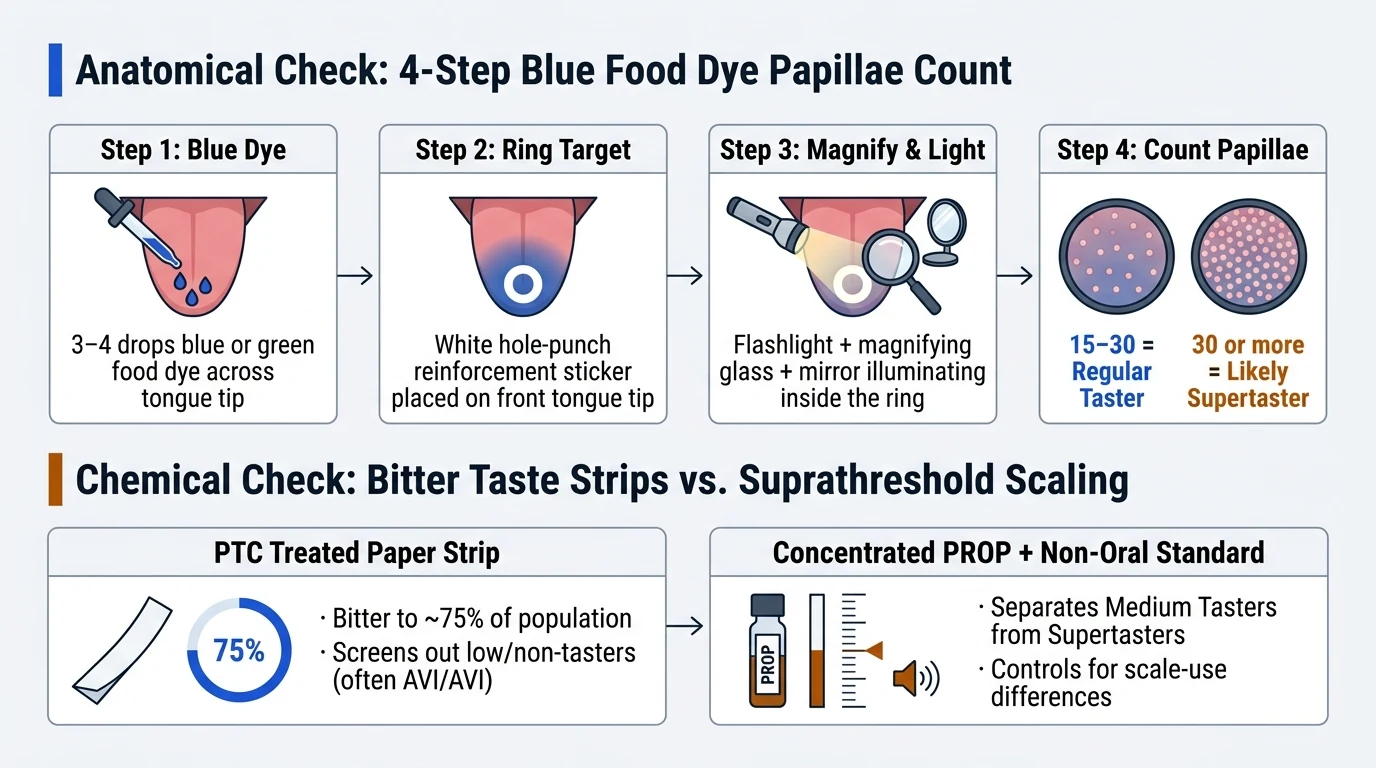
Because supertasters tend to carry more fungiform papillae and pain receptors than regular tasters or non-tasters, examining the anterior tongue provides a practical home self-check. The University of Minnesota Libraries chapter on supertasters outlines the dye-and-ring count in four steps:
- Spread food dye across the tongue tip: Place 3 to 4 drops of blue or green food dye on the tongue and spread it evenly until it covers the entire tip of the tongue.
- Position a counting circle: Place a hole-punch reinforcement sticker—or a small strip of paper with a hole punch in it—on the front end of the tongue.
- Illuminate and magnify the ring: Set up in front of a mirror and use a flashlight and magnifying glass so individual papillae on the tongue are clearly visible.
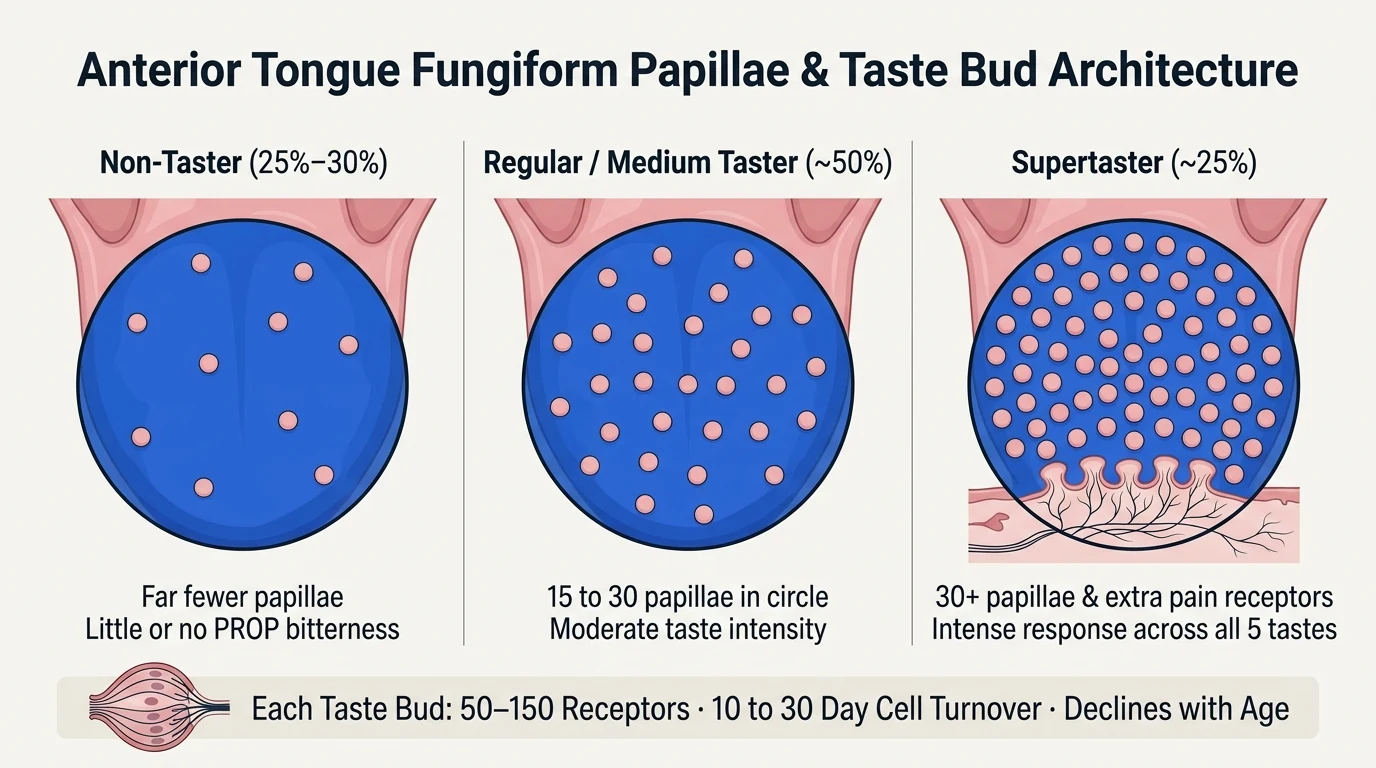
- Count papillae inside the circle: Count the individual papillae within the ring; a regular taster has about 15 to 30 papillae in that area, whereas 30 or more papillae indicates a likely supertaster.
How Do Bitter Taste Test Strips Identify Supertasters?
Bitter taste test strips place specially treated paper carrying phenylthiocarbamide (PTC) or 6-n-propylthiouracil (PROP) on the tongue to activate TAS2R38 bitter receptors, screening out low tasters while requiring concentrated PROP paired with a non-oral standard to separate supertasters from medium tasters without scale-use bias.
As UNC Nutrition Research Institute notes in its nutrigenetics overview, simple test strips of specially treated paper placed on the tongue indicate whether a person is genetically sensitive to certain flavors that may limit intake of specific foods. In practice, PTC strips and laboratory PROP scaling answer different psychophysical questions:
- Historical PTC threshold discovery: Reports of human taste variation date back to 1888, and in 1931 DuPont chemist Arthur L. Fox discovered thiourea taste-blindness when some people found PTC bitter while others found it tasteless. At the 1931 American Association for the Advancement of Science (AAAS) meeting, Fox and geneticist Albert F. Blakeslee tested participants on PTC: 65% found it bitter, 28% found it tasteless, and 6% reported other taste qualities, with subsequent studies proving Mendelian dominant heritability.
- What a modern PTC strip measures: Today, a PTC test strip primarily helps identify whether someone is a low taster, because the general population tastes a PTC strip as bitter about 75% of the time.
- Why PROP replaced PTC in research: In the 1960s, Roland Fischer first connected PTC and propylthiouracil (PROP) tasting ability to food preference, diet, and calorie intake. PROP subsequently replaced PTC in research due to PTC’s faint sulfurous odor and safety concerns.
- Separating supertasters from medium tasters: As summarized in published accounts of supertasting, Linda Bartoshuk and colleagues showed in the 1990s that tasters split into medium tasters (50% of the population) and supertasters (25%), alongside non-tasters (25%). Early studies compared PROP bitterness against a reference salt solution, before discovering that supertasters consume more salt than average tasters. Researchers therefore replaced salt with a non-oral gustatory standard—so when two people rate that non-oral standard at comparable intensity, yet one rates a concentrated PROP solution twice as bitter, the difference reflects real sensory intensity rather than scale use (though many studies still categorize participants using concentrated PROP solution or PROP-impregnated paper without a cross-modal reference).
How Does a Supertaster Tongue Differ in Fungiform Papillae from a Typical Tongue?
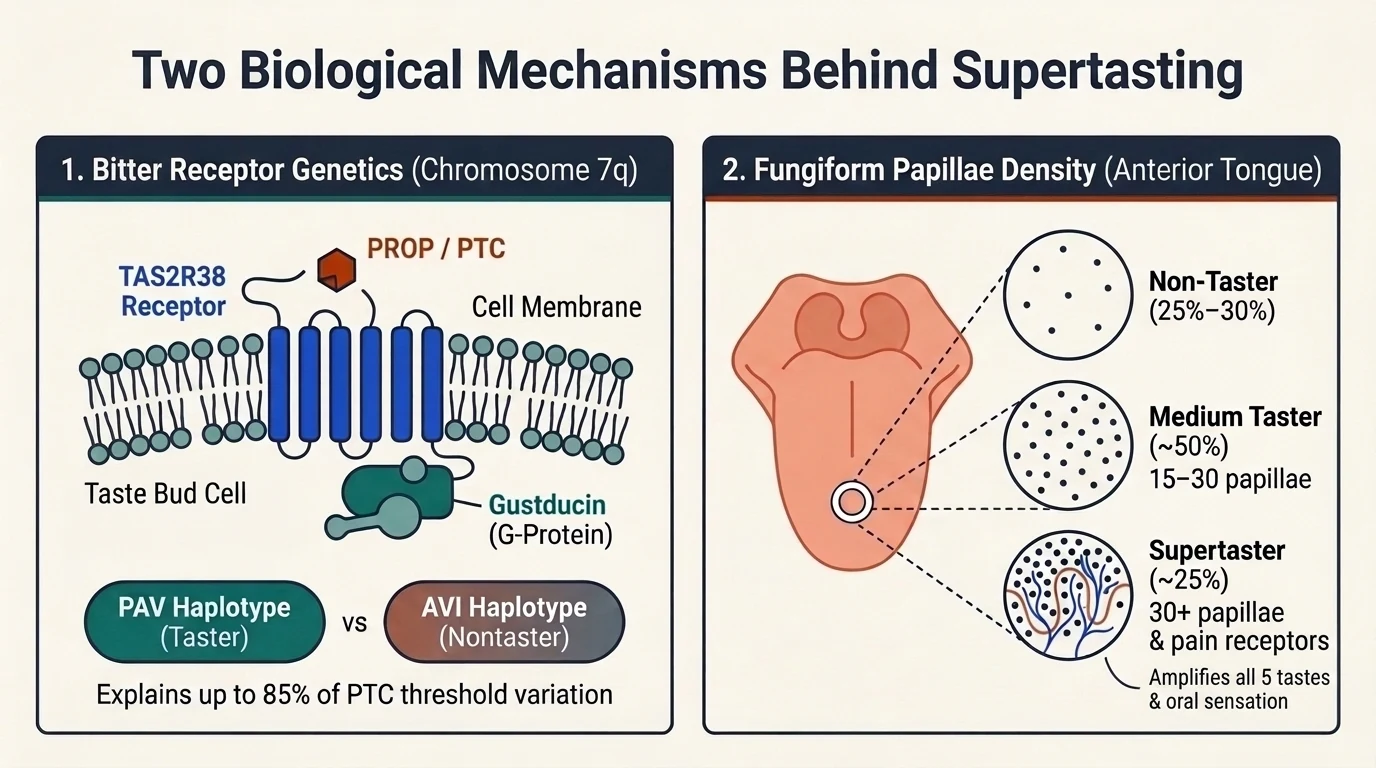
A supertaster tongue carries a denser concentration of fungiform papillae and pain receptors than a typical tongue—reaching 30 or more papillae inside an anterior hole-punch circle versus 15 to 30 in regular tasters—which amplifies perceived intensity across all taste qualities beyond bitter receptor genetics alone.
Taste Bud Receptors, Cell Turnover, and Pain Innervation
An extra number of fungiform papillae allows a supertaster to experience stimuli more potently across all 5 basic tastes—sweet, salty, sour, bitter, and umami (savory, meaty taste)—whereas a non-taster has far fewer fungiform papillae and a lesser sense of taste, with a regular taster in between. Supertasters also tend to have more pain receptors on the tongue than regular tasters and non-tasters.
According to UNC Nutrition Research Institute, individual taste buds contain 50-150 specialized receptors that send messages from the tongue to the brain. Rather than staying fixed for life, each taste bud operates as a dynamic system in which new taste cells are born, mature, perform sensory functions, enter senescence, and die within 10 days to 30 days, while total receptor numbers decline with age.
Why TAS2R38 Genotype Does Not Equal Supertasting
In 2003, allelic variation in the bitter receptor gene TAS2R38 on chromosome 7q was identified as the molecular basis for PTC detection threshold differences and extended to 6-n-propylthiouracil (PROP) sensitivity. Encoded as taste receptor 2 member 38, TAS2R38 uses the G-protein gustducin—requiring both alpha and beta-gamma subunits for signal transduction—and binds 37 distinct ligands cataloged in BitterDB, including PTC, PROP, citrus limonin, the artificial sweetener cyclamate, and the antihistamine chlorpheniramine.
Three common polymorphisms in TAS2R38 (A49P, V262A, and I296V) form two common haplotypes: PAV (often called taster) and AVI (often called nontaster). Combinations of PAV/PAV homozygotes, PAV/AVI heterozygotes, and AVI/AVI homozygotes explain up to 85% of variation in PTC tasting—PAV/PAV individuals report PTC as more bitter than heterozygotes, whereas AVI/AVI individuals often find PTC essentially tasteless.
Yet molecular genetics demonstrate that TAS2R38 alleles alone cannot explain supertasting:
- Multimodal reach: Polymorphisms in a single bitter receptor gene do not account for heightened responses across multiple taste qualities, oral somatosensation, and retronasal olfaction.
- Within-genotype intensity overlap: While TAS2R38 genotypes establish a baseline threshold for PROP tasting, some PAV/PAV homozygotes perceive PROP as more bitter than others, and some PAV/AVI heterozygotes become PROP supertasters despite lacking two PAV alleles.
- Papillae dissociation: Causal links between TAS2R38 and fungiform papillae (FP) number have not been established; TAS2R38 genotype does not explain FP differences, and FP number is not a strong predictor of PROP bitterness among TAS2R38 heterozygotes.
Can Someone Train to Become a Supertaster or Is It Genetic?
No one can train to become a supertaster because supertasting has an innate anatomical and genetic basis—combining heritable bitter receptor alleles with extra tongue fungiform papillae—whereas flavor construction in the brain pairs genetically built-in taste signaling with smell associations that are learned through experience.
UNC Nutrition Research Institute highlights that fundamental split in flavor perception: humans do not directly sense “flavor” on the tongue; instead, the brain constructs flavor from combined taste and smell inputs, where basic taste is built into genes and smell is learned (a distinction explored further in how smell and taste differ). Subsequent genetics research after the 1931 AAAS PTC experiment confirmed that PTC tasting is heritable as a Mendelian dominant trait, while environmental causes may also contribute to sensitive taste through mechanisms that remain under investigation.
Inherited bitter sensitivity carries everyday dietary consequences and demographic patterns without conferring a universal evolutionary advantage:
- Alkaloid protection versus vegetable avoidance: Heightened bitterness sensitivity can help avoid potentially toxic plant alkaloids in some environments, yet it can also limit approach behavior toward palatable foods. Cruciferous vegetables—including broccoli, watercress, mustard greens, turnip, horseradish, and rutabaga—derive perceived bitterness from glucosinolates and hydrolysis products such as isothiocyanates; PAV/PAV individuals find rutabaga twice as bitter as insensitive AVI/AVI subjects, while the PAV/AVI mixed genotype shows an insignificant difference for rutabaga.
- Health and dietary correlates: TAS2R38 genotype has been linked to childhood preference for sweetness, avoidance of cigarette smoking, avoidance of alcoholic beverages, and increased prevalence of colon cancer attributed to inadequate vegetable consumption.
- Demographic distribution: Women and individuals from Asia, South America, and Africa are more likely to be supertasters; female supertasters tend to have a lower body mass index and better cardiovascular health, potentially reflecting a lower predilection for sweet or high-fat foods than average.
How Does Supertaster Sensitivity Affect Perception of Alcohol?
People who perceive 6-n-propylthiouracil (PROP) as more intensely bitter also rate the taste of ethanol as more bitter and less pleasant, and carrying TAS2R38 taster genotypes has been associated with greater avoidance of alcoholic beverages compared with nontaster alleles that predict higher yearly alcohol intake.
Studies comparing PROP bitterness, TAS2R38 haplotypes, and ethanol perception uncover two separate biological contributions rather than a single-gene effect:
- PROP intensity tracks ethanol bitterness: Perceived PROP bitterness correlates directly with perceived alcohol bitterness, and individuals who experience stronger PROP bitterness find ethanol less pleasant.
- TAS2R38 predicts yearly intake, not ethanol bitterness intensity: Correlates between TAS2R38 genotype alone and the perceived bitterness intensity of alcohol were not statistically significant, even though TAS2R38 genotype predicted yearly consumption—individuals carrying nontaster alleles were more likely to consume more alcohol over the year, and TAS2R38 has been linked to avoidance of alcoholic beverages.
- Second anatomical factor: Because PROP bitterness predicts ethanol bitterness where TAS2R38 genotype alone does not, researchers point to a second genetic factor—such as variation governing fungiform papillae density alongside heightened pain receptor innervation—shaping oral responses to alcoholic drinks.
Is Disliking Cilantro the Same Trait as Being a Supertaster?
Disliking cilantro is not the same trait as being a supertaster: supertasting involves heightened tongue taste and somatosensory responses tied to fungiform papillae and chromosome 7q TAS2R38 receptors, whereas soapy repulsion toward coriander leaf stems from nasal olfactory receptor OR6A2 detecting volatile aldehyde odorants.
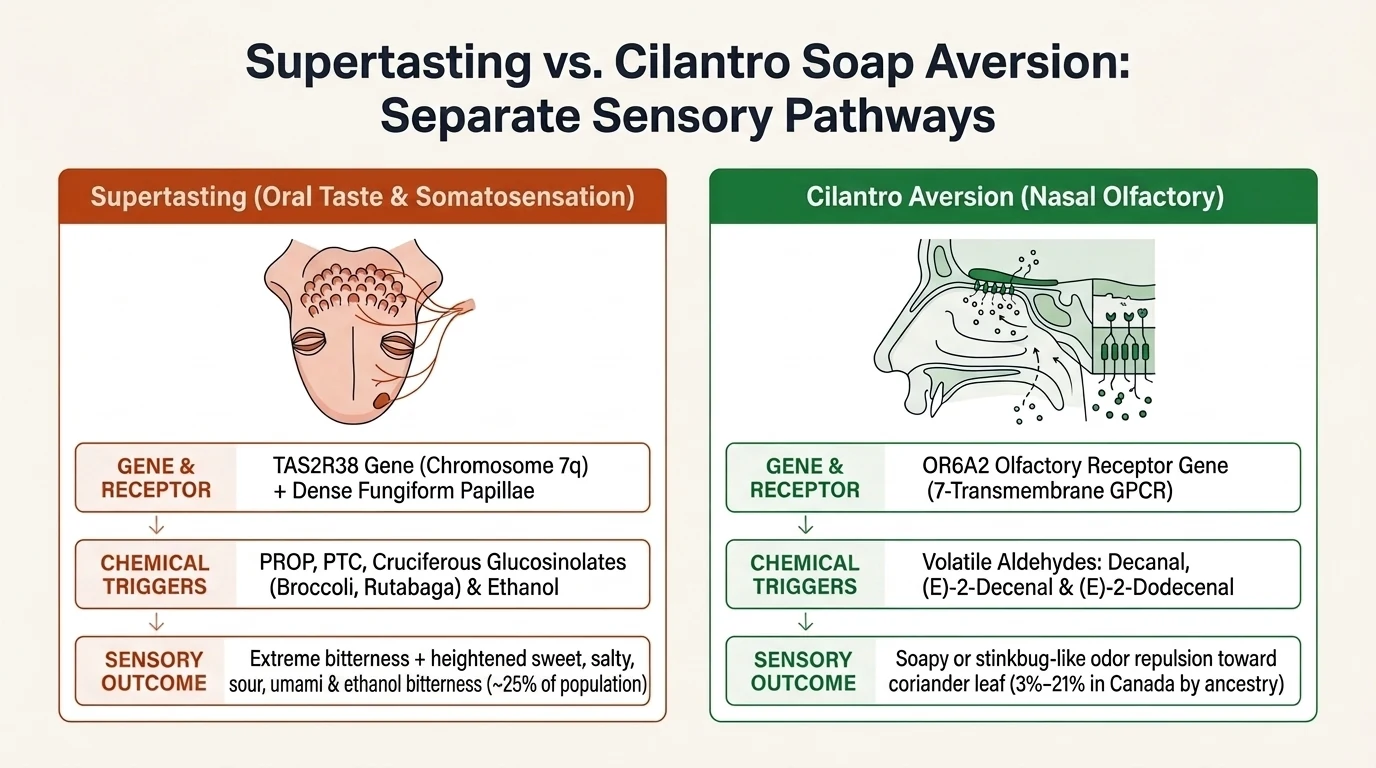
Published genetics research on olfactory receptor OR6A2 separates coriander leaf (cilantro) aversion from oral gustatory supertasting across three dimensions:
- Nasal GPCR transduction: Olfactory receptor 6A2, encoded by the human OR6A2 gene, is a Class II 7-transmembrane G-protein-coupled receptor (GPCR) that binds odorant molecules inside the nose to initiate smell perception.
- Shared aldehyde chemistry: People repulsed by cilantro often compare its flavor to soap, vomit, or foul-smelling stinkbug odor—an effect linked to unsaturated and saturated aldehydes including decanal, (E)-2-decenal, and (E)-2-dodecenal, which occur in coriander as well as soaps, detergents, and secretions of stinkbugs including Halyomorpha halys.
- Ancestry-linked dislike prevalence: Depending on ancestry, between 3% and 21% of the Canadian population report disliking coriander: 21% for East Asians, 17% for Europeans, 14% for individuals of African descent, 7% for South Asians, 4% for Hispanics, and 3% for Middle Eastern subjects (figures that measure self-reported coriander dislike rather than OR6A2 allele prevalence).
How Should Sensory Panels Record Taster Baseline Differences?
Sensory panel recruitment records baseline taste differences by separating phenylthiocarbamide (PTC) threshold strip screening from concentrated propylthiouracil (PROP) scaling against a non-oral standard, logging anterior tongue fungiform papillae counts, and keeping oral bitter sensitivity distinct from nasal OR6A2 odorant responses during assessor intake.
Individual-Difference Baseline Checklist for Sensory Panel Recruitment
When recruiting assessors or interpreting hedonic spread in small sensory tests alongside odor detection and recognition threshold checks, use the baseline checklist below so non-tasters, medium tasters, and supertasters are not conflated:
| Baseline Check | Screening Protocol & Reference Basis | Non-Taster Baseline | Medium Taster Baseline | Supertaster Baseline |
|---|---|---|---|---|
| PTC paper strip screen | Place treated PTC strip on the tongue (tastes bitter to about 75% of the general population; 1931 AAAS check logged 65% bitter, 28% tasteless, 6% other) | Frequently reports PTC as tasteless (often AVI/AVI homozygotes) | Reports PTC strip as bitter | Reports PTC strip as bitter; strip threshold alone does not separate medium from super |
| Suprathreshold PROP & non-oral standard | Rate concentrated PROP solution or PROP paper alongside a non-oral gustatory standard (replacing reference salt because supertasters consume more salt than average tasters) | Perceives little to no bitterness (25% in Bartoshuk’s split; 25 to 30% in UNC Nutrition Research Institute accounts) | Moderate PROP bitterness (50% of population in Bartoshuk’s split) | Extreme PROP bitterness (such as twice the bitterness rating at matched standard intensity; roughly 25% of population) |
| Anterior tongue blue-dye count | Spread 3 to 4 drops of blue or green food dye over the tongue tip and count papillae inside a hole-punch circle using mirror, flashlight, and magnifier | Far fewer fungiform papillae on the tongue than regular tasters | About 15 to 30 fungiform papillae inside the hole-punch circle | 30 or more papillae inside the circle, carrying more fungiform papillae and pain receptors than tasters and non-tasters |
| TAS2R38 genotype scope | Separate chromosome 7q TAS2R38 haplotypes (PAV vs AVI, up to 85% of PTC variance) from whole-mouth supertasting | AVI/AVI insensitive to rutabaga glucosinolates; nontaster alleles predict higher yearly alcohol intake | PAV/AVI mixed genotype shows insignificant rutabaga difference, though some heterozygotes are PROP supertasters | PAV/PAV rates rutabaga twice as bitter as AVI/AVI; heightened across all 5 tastes, oral somatosensation, and alcohol bitterness |
| OR6A2 cilantro boundary | Record repulsion toward coriander leaf (cilantro) separately; self-reported coriander dislike in Canada ranges between 3% and 21% by ancestry | Nasal OR6A2 7-transmembrane GPCR smell response rather than tongue bitter status | Nasal OR6A2 smell response to volatile aldehydes rather than tongue bitter status | Driven by decanal, (E)-2-decenal, and (E)-2-dodecenal in coriander, soaps, and stinkbugs rather than TAS2R38 |
| Age & receptor turnover | Log assessor age alongside screening date because each taste bud holds 50-150 receptors that regenerate every 10 days to 30 days and decline in number with age | Low baseline receptor sensitivity | Intermediate sensitivity subject to age-related receptor decline | High papillae density subject to gradual age-related receptor decline |