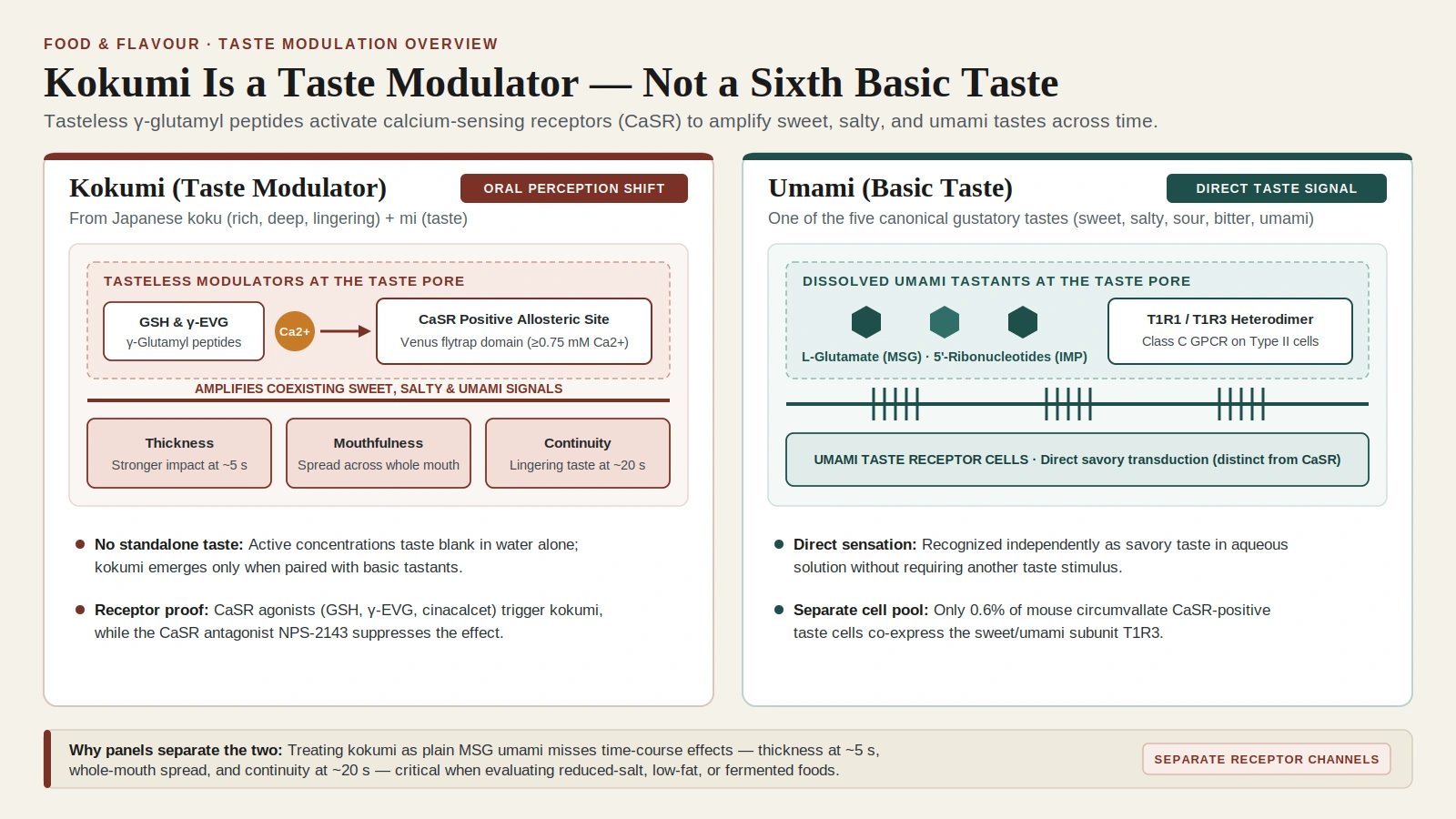
Kokumi is a taste-modulating oral perception—rather than a standalone basic taste—in which tasteless compounds such as glutathione and γ-glutamyl peptides activate extracellular calcium-sensing receptors (CaSR) on tongue taste cells. When combined with sweet, salty, or umami tastants, these modulators amplify perceived thickness, whole-mouth fullness, and lingering continuity across the tasting sequence.
Because kokumi enhancers work below their aqueous taste thresholds, tasters often mistake kokumi richness for extra monosodium glutamate (MSG) and overlook the time-course indicators that separate the two. Within food and flavour, distinguishing taste modulation from primary taste sits alongside packaging and food expectations and complements how taste and smell differ.
| Sensory Dimension | Kokumi (Taste Modulator) | Umami (Basic Taste) |
|---|---|---|
| Classification | Integrated oral perception triggered by taste modulators | One of five canonical basic tastes (sweet, salty, sour, bitter, umami) |
| Standalone taste in water | No basic taste at active food concentrations | Directly recognized as an independent savory taste |
| Primary taste receptor | Extracellular calcium-sensing receptor (CaSR), a class C GPCR | T1R1/T1R3 heterodimer on Type II taste receptor cells |
| Taste-bud cell overlap | Expressed in Type II (43.1% PLCβ2+) and Type III (64.7% NCAM+) cells; only 0.6% co-express T1R3 | Expressed in Type II receptor cells expressing T1R3, separate from CaSR cells |
| Key perceptual outputs | Thickness (~5 s), mouthfulness (whole mouth), and continuity (~20 s) | Primary savory gustatory sensation from glutamate and ribonucleotides |
What Does Kokumi Mean in Taste and Flavor Science?
In flavor science, kokumi combines two Japanese words—koku (strong, rich, concentrated, deep, complex, and lingering) and mi (taste)—to designate the specifically taste-related oral perception of thickness, mouthfulness, and continuity enhanced by tasteless compounds in food. Researchers separate kokumi from the broader Japanese concept of koku, which integrates taste, aroma, and texture together.
As reviewed by Kitajima and Goda in Chemical Senses (2026), koku appears widely on Japanese food packaging for beer, coffee, chocolate, ice cream, curry roux, and soy sauce to signal rich, lasting palatability. Adding mi narrows the scope to taste-related perception inside the oral cavity rather than olfactory aroma release, which belongs to retronasal olfaction and aroma release.
Modern scientific work on kokumi began in 1990, when Ueda and colleagues isolated glutathione (GSH: γ-Glu-Cys-Gly) from garlic extracts as the first identified kokumi food component. In their 1990, 1994, and 1997 studies, Ueda’s group defined kokumi substances as compounds that carry no basic taste on their own yet enhance taste-related oral perceptions—specifically thickness, mouthfulness, and continuity—when added to basic taste solutions or foods.
Even as publication volume has expanded, Kitajima and Goda (2026) emphasize that there is still no international consensus on a single standardized definition of kokumi. Across research groups, however, the core operational descriptors consistently center on complexity, thickness, mouthfulness, and continuity of taste.
Is Kokumi a Basic Taste or a Taste Modulator?
Kokumi is a taste modulator and integrated oral perception, not a sixth basic taste. Unlike sweet, salty, sour, bitter, and umami—which are directly detected by dedicated tongue receptors as independent primary sensations—kokumi substances elicit no basic taste on their own at active food levels and require coexisting basic tastants to alter flavor perception.
The five canonical basic tastes generate direct gustatory sensations when dissolved tastants bind specific receptors: T1R2/T1R3 for sweetness, T1R1/T1R3 for umami, and the T2R receptor family for bitterness. Because each basic taste is recognized independently in water without needing another tastant, sensory scientists classify those five qualities as primary sensory sensations.
Kokumi compounds behave differently in aqueous solution:
- Blank baseline in water: In Ohsu and colleagues’ landmark Journal of Biological Chemistry study (2010), human sensory analyses showed that extracellular calcium-sensing receptor (CaSR) agonists enhance sweet, salty, and umami tastes even though they have no taste themselves.
- High aqueous recognition thresholds: Kitajima and Goda (2026) cite Dunkel and colleagues’ finding that glutathione’s aqueous taste recognition threshold is 3.1 mM (0.092%), where it produces only a faint astringent feel and no basic taste—whereas mixing glutathione into sodium chloride (NaCl) or L-glutamate solutions drops its sensory threshold markedly.
- Matrix-dependent emergence in aged sauces: In human sensory testing by Rhyu and colleagues in Nutrients (2020), adding 0.3% of a mature Korean soy sauce kokumi peptide fraction (FIIm) to an umami soup base significantly raised umami intensity (p < 0.01, n = 9), whereas the exact same concentration in water rated below 1.
Because kokumi emerges only when modulators combine with basic tastants and undergo central integration in the brain, current chemosensory reviews classify kokumi as a modulated oral perception operating through two main functions: imparting or enhancing oral perception (thickness, mouthfulness, continuity) and modulating basic taste intensity—usually amplifying sweet, salty, and umami tastes while occasionally suppressing bitterness or sourness.
How Does Kokumi Differ from Umami?
Umami is a primary savory taste detected directly through T1R1/T1R3 taste receptors, whereas kokumi is a time- and space-expanding modulation mediated largely by calcium-sensing receptors (CaSR) on an independent population of taste cells. Adding kokumi peptides does not simply mimic MSG; it amplifies early impact (~5 s), broadens whole-mouth spread, and extends lingering finish (~20 s).
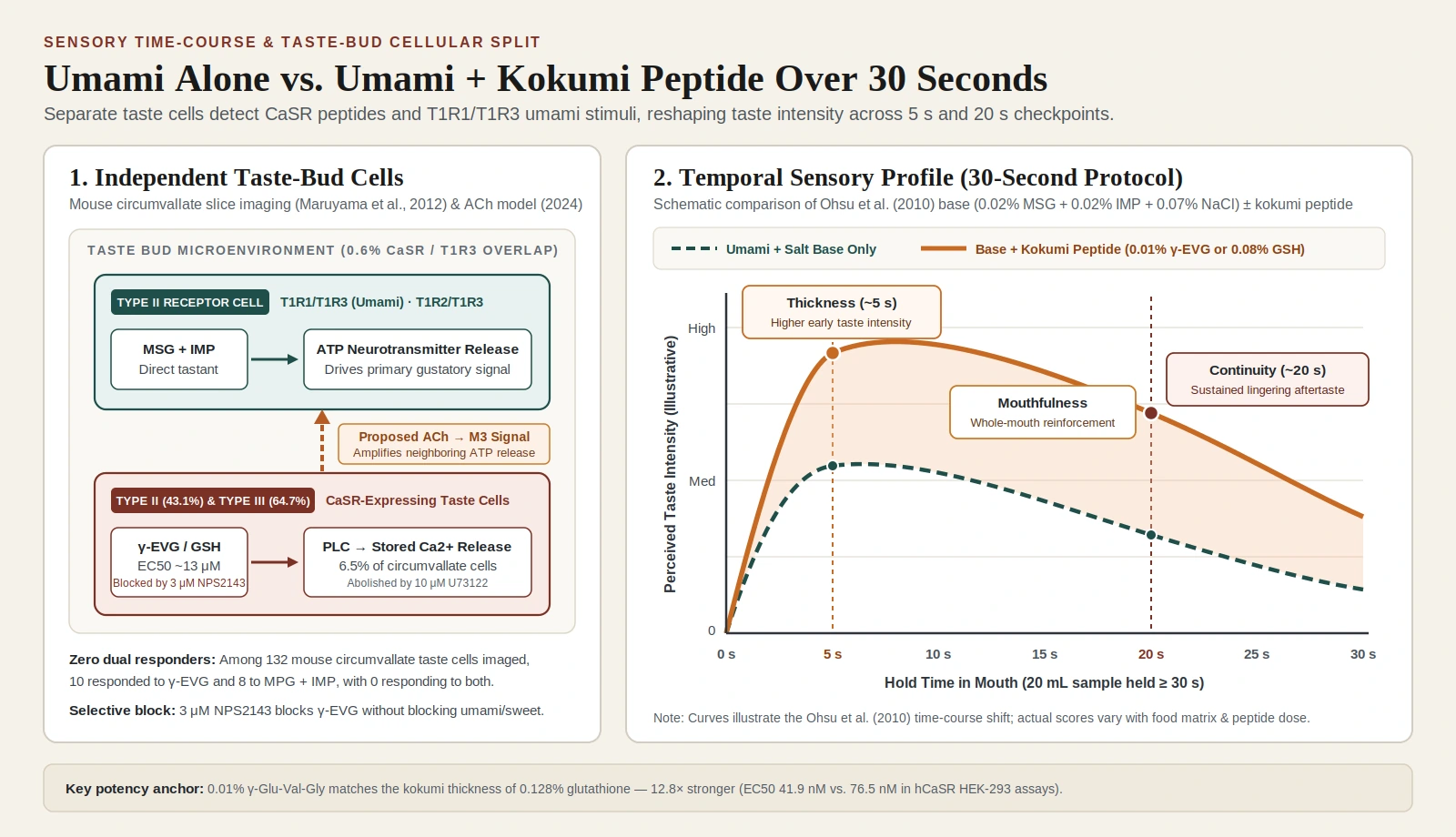
Cellular imaging in Maruyama and colleagues (PLoS ONE, 2012) established that the tongue detects umami and kokumi compounds through separate cellular channels:
- Virtually zero receptor co-expression: Dual immunohistochemistry across 63 mouse circumvallate taste buds identified 502 taste cells expressing CaSR and 347 taste cells expressing the sweet/umami subunit T1R3, with only 3 cells (0.6% of CaSR-positive taste cells) expressing both.
- Mutually exclusive cellular responses: In functional calcium imaging across 132 mouse circumvallate taste cells from 16 lingual slices, 10 cells responded to the potent kokumi tripeptide γ-Glu-Val-Gly (γ-EVG) and 8 cells responded to an umami stimulus of monopotassium L-glutamate (MPG) plus inosine monophosphate (IMP), with zero cells responding to both.
- Selective pharmacological blockade: Pretreating mouse lingual slices with 3 µM NPS-2143—a CaSR-specific antagonist—selectively blocked γ-EVG calcium responses while barely affecting umami (100 mM MPG + 1 mM IMP) or sweet (100 µM SC45647) responses. In Ohsu and colleagues’ (2010) human trials, NPS-2143 likewise significantly suppressed perceived kokumi taste.
In practical tasting, this receptor split explains why replacing a fermented stock with plain MSG can hit an immediate savory note yet feel thin and fade quickly. Umami supplies the savory baseline; kokumi modulates how thick, mouth-filling, and persistent that baseline feels over 20 to 30 seconds.
What Are Kokumi Peptides and How Do They Activate Taste Receptors?
Kokumi peptides are short, largely tasteless amino acid chains—most notably γ-glutamyl peptides such as glutathione (GSH) and γ-Glu-Val-Gly (γ-EVG)—that act as positive allosteric modulators of the extracellular calcium-sensing receptor (CaSR) on taste cells. Their potency scales closely with CaSR activation strength, though α-peptides, aged Maillard peptides, and additional candidate receptors also contribute.
Positive Allosteric Activation of CaSR
Ohsu and colleagues (2010) proved that CaSR mediates human kokumi perception by testing both peptide and non-peptide CaSR activators—including calcium, protamine, polylysine, L-histidine, and the calcimimetic drug cinacalcet—all of which elicited kokumi thickness in salty-umami base solutions while NPS-2143 suppressed the sensation. Crucially, GSH and γ-EVG required a physiological basal calcium level of at least 0.75 mM (comparable to human saliva and plasma) to activate CaSR, indicating partial allosteric agonism.
Recent cryo-EM structural analyses and point-mutant assays summarized by Kitajima and Goda (2026) pinpoint how that activation works: γ-glutamyl peptides bind allosteric pockets adjacent to the orthosteric calcium-binding site inside CaSR’s extracellular Venus flytrap domain, boosting the receptor’s sensitivity to calcium ions. Potency varies sharply by peptide length and sequence:
| Kokumi Peptide / Fraction | Chemical Class | Human CaSR EC50 (HEK-293) | Sensory Potency or Effective Concentration |
|---|---|---|---|
| γ-Glu-Val-Gly (γ-EVG) | γ-Glutamyl tripeptide | 41.9 nM | 12.8× stronger than GSH (0.01% matches 0.128% GSH); active ~5 ppm (16 µM) in foods |
| Glutathione (GSH; γ-Glu-Cys-Gly) | γ-Glutamyl tripeptide | 76.5 nM | Reference standard; aqueous threshold 3.1 mM (0.092%) with no basic taste |
| γ-Glu-Abu-Gly | γ-Glutamyl tripeptide | 18.1 nM | Reaches Emax 25.6% of calcium maximum in HEK-293 CaSR screening |
| γ-Glu-Cys | γ-Glutamyl dipeptide | 458 nM | Reaches Emax 38.0% of calcium maximum in human CaSR assay |
| γ-Glu-Val | γ-Glutamyl dipeptide | 1.34 µM | Reaches Emax 53.3% of calcium maximum in receptor potency testing |
| γ-Glu-Ala | γ-Glutamyl dipeptide | 3.65 µM | Reaches Emax 42.6% of calcium maximum in Ohsu et al. (2010) assay |
| Food α-peptides (yeast, cocoa, soy) | α-Linked di-/oligopeptides | Not uniformly standardized | Effective at ~100 to 1,000 µM (less potent than γ-EVG at ~15 to 100 µM) |
| Mature Ganjang fraction (FIIm) | 500–10,000 Da Maillard peptides | Non-CaSR / TRPV1 pathway tested | Enhances human saltiness at 0.3% to 0.5% and umami at 0.3% |
Independent Taste Cells and Proposed Paracrine Signaling
In mouse circumvallate papillae, Maruyama and colleagues (2012) localized CaSR to both Type II receptor cells (314 of 728 CaSR-positive cells, or 43.1%, co-expressed PLCβ2) and Type III presynaptic cells (669 of 1,033 cells, or 64.7%, co-expressed NCAM). Focally applying γ-EVG triggered intracellular calcium transients in 6.5% of circumvallate taste cells (34 of 524 cells across 26 mice) with an estimated EC50 of ~13 µM, while concentrations above 30 µM recruited no extra cells.
Those calcium signals depend on phospholipase C (PLC) releasing calcium from intracellular stores rather than extracellular calcium influx: pretreating lingual slices with 10 µM of the PLC inhibitor U73122 nearly abolished γ-EVG responses (dropping peak fluorescence change from 8.3 ± 1.6% to 1.7 ± 0.8%, n = 4).
To explain how CaSR cells amplify separate sweet and umami receptor cells, Kitajima and Goda (2026) review Maruyama’s (2024) proposed paracrine model: CaSR activation by γ-EVG prompts acetylcholine (ACh) secretion, which stimulates muscarinic receptors (such as M3) on neighboring sweet-taste receptor cells and boosts ATP neurotransmitter release. At the same time, the review stresses that the exact downstream pathways generating thickness, mouthfulness, and continuity—as well as salt enhancement—have not yet been fully established.
Non-CaSR Candidates and Maillard Peptide Pathways
Kokumi modulation is not limited to γ-glutamyl peptides acting on CaSR alone:
- Aged Maillard peptides and salt modulation: Rhyu and colleagues (2020) isolated a 500–10,000 Da peptide fraction (FIIm) from 4-year-old Korean soy sauce (Ganjang) that modulated rodent amiloride- and benzamil-insensitive NaCl chorda tympani responses biphasically—enhancing at 0.1% to 0.5% and inhibiting above 0.5%—through a TRPV1-dependent mechanism.
- Additional candidate GPCRs: Kitajima and Goda (2026) summarize evidence for GPRC6A (a class C GPCR activated by L-ornithine in rodents and cats), GPR92/LPAR5 (protein hydrolysates), and GPR120, which is expressed in human taste buds and enhances fat-like mouth coating and lastingness when stimulated by tasteless concentrations of oleic acid, linoleic acid, or synthetic GPR120 agonists.
- Bitterness suppression via CaSR and T2R co-expression: CaSR is also co-expressed in taste cells carrying T2R bitter receptors, where direct protein-protein interaction between CaSR and T2Rs is proposed to help explain why γ-EVG suppresses bitterness alongside sourness.
Which Culinary Ingredients Naturally Contribute Kokumi?
Naturally occurring kokumi peptides accumulate in alliums, legumes, ripened cheeses, fermented sauces, seafoods, and yeast extracts—especially wherever enzymatic proteolysis, microbial fermentation, or long aging liberates γ-glutamyl peptides, α-peptides, and Maillard-conjugated peptides. These culinary sources deliver mouthfulness and depth at concentrations far lower than their standalone water thresholds.
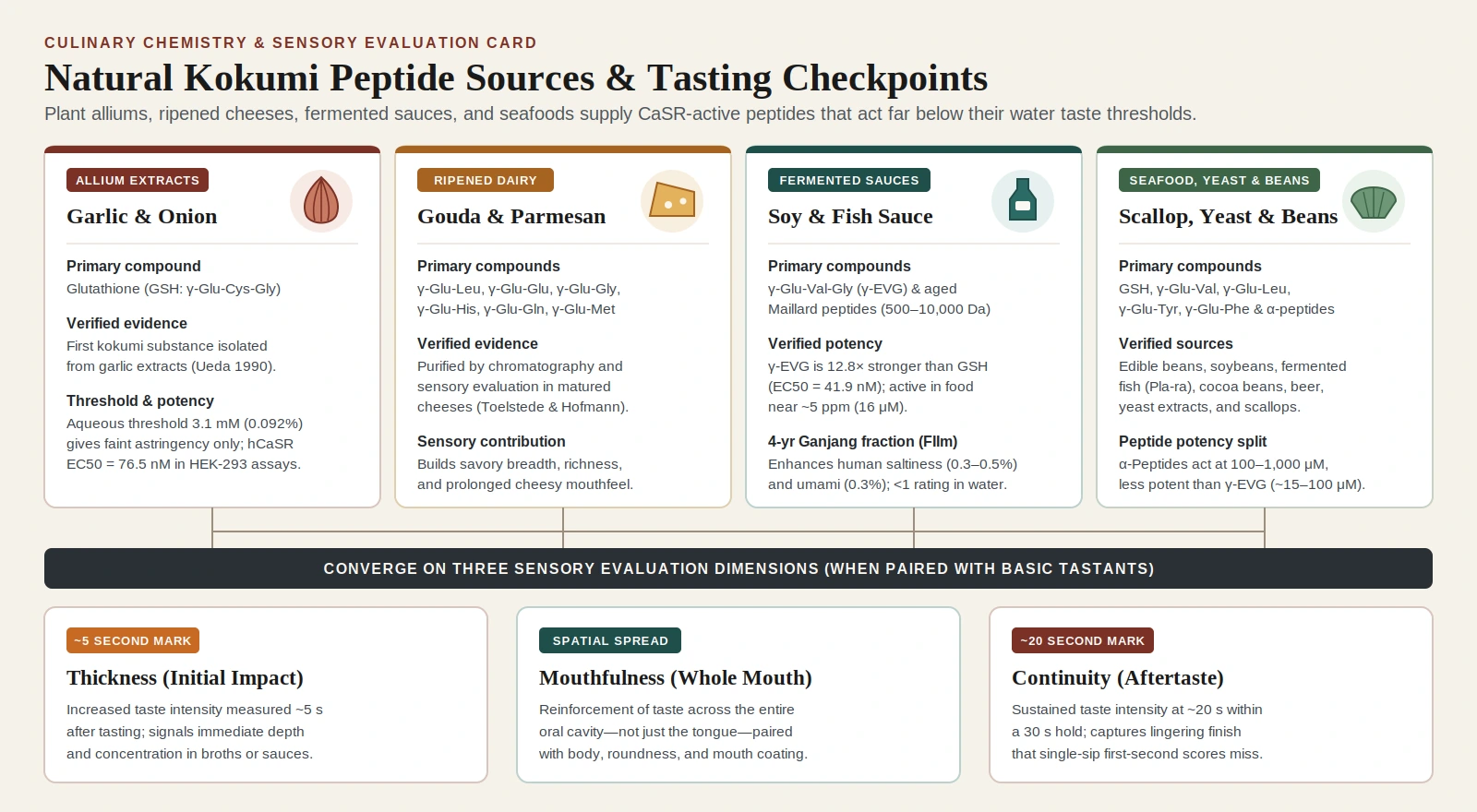
Peer-reviewed chromatographic purifications and sensory evaluations reviewed by Kitajima and Goda (2026) and Rhyu and colleagues (2020) trace distinct kokumi peptide families across major ingredient groups:
| Culinary Ingredient Group | Verified Kokumi Compounds | Reported Sensory Role |
|---|---|---|
| Garlic and onion | Glutathione (GSH; γ-Glu-Cys-Gly) | Enhances thickness, mouthfulness, and continuity in savory broths and taste bases |
| Gouda and Parmesan cheeses | γ-Glu-Leu and related γ-glutamyl dipeptides (plus γ-EVG in cheese) | Contributes mature savory breadth, richness, and prolonged taste complexity |
| Soy sauce and fish sauce | γ-Glu-Val-Gly (γ-EVG), 4 α-peptides in soy sauce, and 500–10,000 Da Maillard peptides (4-year Ganjang FIIm) | Amplifies saltiness (0.3%–0.5% FIIm), umami (0.3% FIIm), and lingering body |
| Scallop and fermented fish (Pla-ra) | Glutathione (scallop), γ-Glu-Val, γ-Glu-Leu, and γ-EVG (fermented fish) | Reinforces savory mouthfulness and continuous umami finish |
| Yeast extract and beer | Glutathione, six Leu-containing α-dipeptides (yeast extract), and γ-EVG (beer) | Builds mouthfeel, thickness, and continuity across soups and fermented beverages |
| Edible beans, soybeans, and fermented cocoa | γ-Glu-Val, γ-Glu-Leu (beans), γ-Glu-Tyr, γ-Glu-Phe (soybeans), and 5 kokumi α-peptides (cocoa) | Adds taste breadth, complexity, mouthfulness, and continuity |
Potency differences explain why tiny additions of long-fermented sauces or aged cheeses reshape a dish more efficiently than simple protein digests. Whereas food-derived α-peptides act at 100 to 1,000 µM to modulate flavor, γ-glutamyl tripeptides such as γ-EVG exert measurable kokumi effects at approximately 5 ppm (16 µM) across varied food systems.
How Is Kokumi Evaluated in Sensory Panels and Product Formulation?
Evaluating kokumi accurately requires tracking taste intensity across time—rather than recording a single instant score—using standardized checkpoints for thickness (~5 s), mouthfulness (whole-mouth spread), and continuity (~20 s). Separating these temporal dimensions prevents formulators from confusing fading basic-taste intensity with kokumi modulation during reduced-salt, low-fat, or plant-based development.
In Ohsu and colleagues’ (2010) continuous human sensory protocol, panelists received 20 mL samples of a mild umami-and-salt base (0.02% MSG, 0.02% IMP, and 0.07% NaCl) with or without 0.08% GSH or 0.01% γ-EVG and held each sample in the mouth for at least 30 seconds. Single-taste modulation trials paired 0.1% GSH or 0.01% γ-EVG with 3.3% sucrose (sweet), 0.9% NaCl (salty), or 0.5% MSG (umami), while foodstuff testing used 2% chicken consommé with 0.02% GSH or 0.002% γ-EVG.
When training tasters—which follows the panel calibration principles detailed in our descriptive sensory analysis panel guide—panels should separate basic taste strength from kokumi’s temporal and spatial cues using the terminology card below:
| Evaluation Dimension | Operational Definition | Typical Measurement Anchor | Common Confounding Error |
|---|---|---|---|
| Thickness | Surge in early taste impact, concentration, and amplitude | Taste intensity rated at ~5 s after tasting | Mistaking flat first-second saltiness or MSG spike for sustained body |
| Mouthfulness | Spread and reinforcement of taste throughout the oral cavity | Whole-mouth sensation beyond the tongue surface | Attributing mouth coating solely to physical viscosity or fat content |
| Continuity | Sustained taste duration and lingering aftertaste | Taste intensity rated at ~20 s during a ≥30 s hold | Ending scoring after only a few seconds and missing persistence |
| Extended kokumi lexicon | Complexity, richness, density, body, roundness, depth, punch, fatty, and mouth coating | Paired against an unmodulated base control | Scoring kokumi compounds in plain water where they have no basic taste |
This measurement discipline matters directly in food reformulation. Kitajima and Goda (2026) document that 0.01% γ-EVG enhances thickness in chicken consommé, hamburger steak, orange-flavored drinks, low-fat peanut butter, low-fat French dressing, and low-fat custard cream—even amplifying fatty orosensation (oiliness) in reduced-fat matrices. Because plant-based meat and dairy alternatives frequently exhibit weaker thickness, mouthfulness, and continuity than animal-derived counterparts—and bean proteins can introduce bitterness—kokumi peptides that boost savory or sweet depth while suppressing bitterness offer a targeted sensory lever for reduced-salt, reduced-fat, reduced-sugar, and plant-based foods.