Top, middle, and base notes describe how a single fragrance mixture shifts in perceived character over time as molecules with different vapor pressures, odor detection thresholds, and skin substantivities evaporate simultaneously from the same film. Under Poucher’s paper-strip scale, top notes score below 15, middle notes span 15 to 60, and base notes exceed 60.
Within beauty and personal care sensory evaluation, separating normal evaporation stages from fragrance oxidation and storage drift or cosmetic skin-feel perception prevents a classic testing mistake: judging a formula from its first bright citrus spray before the heart accord and fixative dry-down emerge.
What Are Top, Middle (Heart), and Base Notes in a Fragrance?
Top (head), middle (heart), and base (bottom or soul) notes are olfactory volatility tiers that describe which portion of a perfume dominates the air at successive intervals after application. Rather than releasing from separate compartments, all three layers volatilize concurrently and continuously modify how one another smell.
As summarized by Zarzo in Sensors, perfumes mix odorous raw materials with markedly different volatilities, and the parameter measuring a material’s lasting property on skin is called substantivity or tenacity. Vapor pressure is the primary physical driver of a compound’s volatility, yet predicting the exact vapor composition above a finished blend is complex because dissolved fragrance molecules interact in the liquid phase.
The familiar perfume pyramid metaphor first appeared in the 19th century and was popularized by François Coty, creator of Chypre in 1917, as documented in the perfumery note reference. Crucially, notes do not act in isolation: the presence of heart and base notes alters the scent perceived even when top notes are strongest, while middle notes round out and mask the often harsh initial impression of heavy base materials before dry-down settles.
To turn descriptive tiers into reproducible benchmarks, W. A. Poucher tested 332 odorous materials on paper smelling strips, measured how long each strip retained its characteristic odor, and assigned a coefficient of substantivity (CS) from 1 to 100. Odorants with CS below 15 classify as top notes, materials from 15 to 60 classify as middle notes, and materials above 60 classify as base notes.
| Note Tier | Alternate Names | Poucher CS (1–100) | Carles Skin Timeline | Functional Role in Composition | Representative Materials |
|---|---|---|---|---|---|
| Top notes | Head notes, opening notes | 1 to 14 (below 15) | 15–30 minutes (blooming phase) | Delivers immediate fresh opening impact via small, volatile molecules | Bergamot, lemon, lime, lavender, green notes |
| Middle notes | Heart notes | 15 to 60 | 3–4 hours (development phase) | Forms the main body of the blend and rounds off harsh initial base notes | Jasmine, rose, geranium, clove, spicy and floral accords |
| Base notes | Bottom notes, soul notes | 61 to 100 | More than 4 hours (lasting phase; past 24 hours for some musks) | Acts as low-volatility fixative anchor that holds and deepens lighter notes | Sandalwood, patchouli, vanilla, oakmoss, amber, musk |
How Do Top, Middle, and Base Notes Evolve on Skin Versus Blotters?
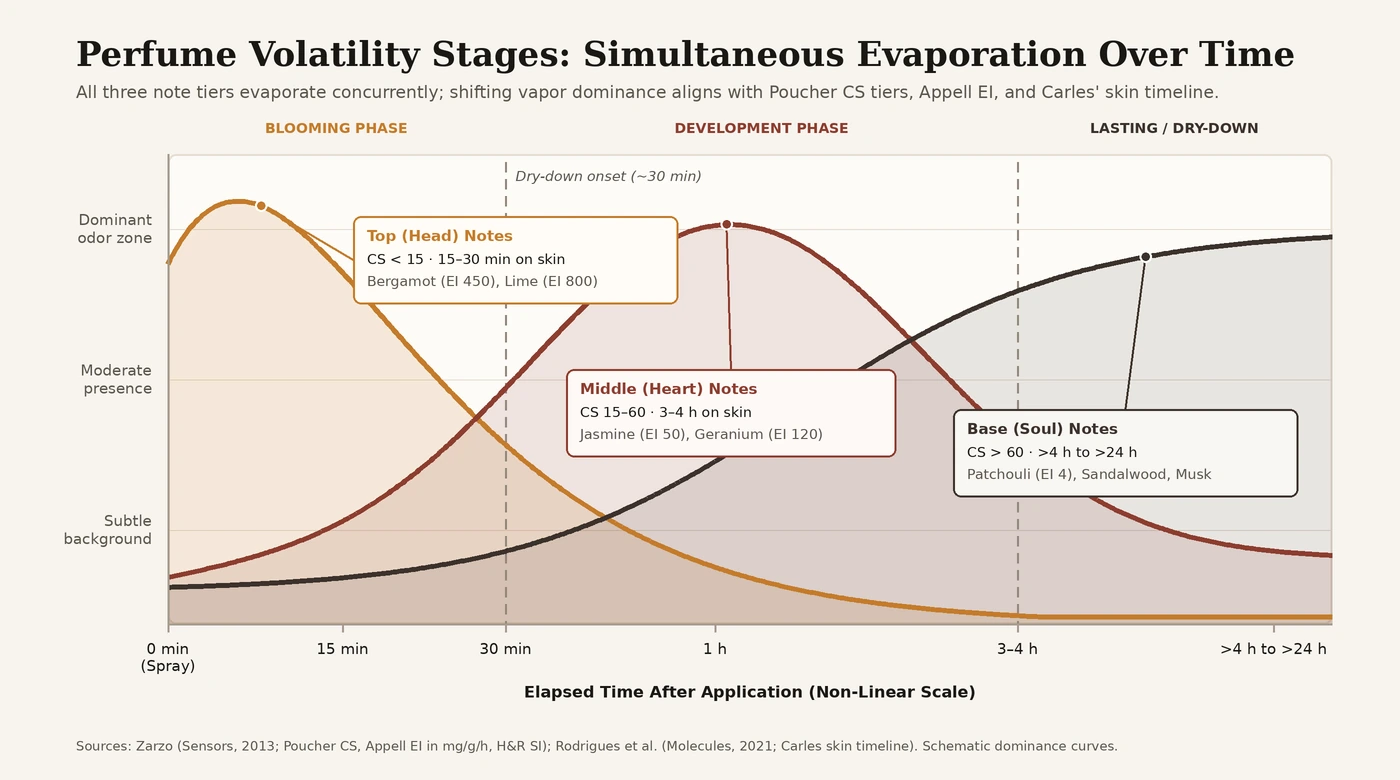
Perfume evolution follows a four-step chain—liquid evaporation, airborne diffusion, sensory intensity perception, and odor character recognition—shifting from the top-note blooming phase (15 to 30 minutes) through middle-note development (3 to 4 hours) into base-note dry-down (emerging around 30 minutes and lasting past 4 hours). Skin permeation, lipid levels, and solvent retention make wear on skin diverge sharply from paper strips.
In a chemical engineering review by Rodrigues, Nogueira, and Faria in Molecules, the first two steps of fragrance perception (evaporation and gas-phase diffusion) belong to thermodynamics and transport phenomena, whereas perceived odor intensity and character belong to psychophysics. Perfumers evaluate that temporal-spatial progression using four distinct metrics:
- Impact: Immediate olfactory sensation upon application during the blooming phase.
- Tenacity: Persistence of the fragrance near the application site as evaporation progresses.
- Diffusion: Efficacy of scent transport at a distance from the wearer or source.
- Volume: Combined effectiveness of the fragrance across both elapsed time and spatial distance.
Diffusion Timelines and Dry-Down Transitions
Rodrigues and colleagues modeled a three-component mixture containing limonene (top note), geraniol (middle note), and vanillin (base note) in ethanol using a one-dimensional diffusion tube near the evaporation surface. Near the source, limonene dominates perception first during opening evaporation, and geraniol overtakes the dominant odor zone after 1 hour.
General perfumery summaries note that certain light heart-note compounds begin dissipating between twenty minutes and one hour after application, while Carles’ skin pyramid records full middle-note persistence across 3 to 4 hours. Base notes made of large, heavy, slow-evaporating molecules are typically not distinctly perceived until roughly 30 minutes after application during dry-down, and certain animalic and musk base notes remain detectable more than 24 hours after application.
Why Paper Blotters Diverge from Living Skin
Paper smelling strips measure pure evaporative retention in an inert cellulose fiber matrix, which is how Poucher built his 332-material CS scale. Zarzo explicitly notes that both olfactory perception and substantivity of a raw material can change drastically when it moves from a single-ingredient paper blotter into a multicomponent perfume mixture or onto human skin.
Living skin adds selective dermal permeation and surface chemistry. Using pig-ear skin in infinite-dose Franz diffusion cells with ethanol solutions, Rodrigues and colleagues measured skin permeation coefficients of 1.08 × 10⁻⁵ cm/h for alpha-pinene, 8.25 × 10⁻⁶ cm/h for limonene, and 2.15 × 10⁻³ cm/h for linalool—meaning linalool permeated roughly two orders of magnitude faster than the two hydrocarbon monoterpenes. As noted in the perfume reference overview, wearer physiology also alters retention: dry skin holds fragrance less long than skin with higher natural oil content, and skin hydration affects longevity after application.

Which Scent Families Belong in Top, Middle, and Base Notes?
Across 820 commercial perfumes cataloged in the H&R Fragrance Guide (367 men’s and 453 women’s), perceptual freshness correlates strongly and negatively with substantivity (r = −0.85), placing bright citrus, green, and herbal descriptors squarely in top notes, florals in middle notes, and woody, vanilla, amber, oakmoss, and musk accords in base notes.
To quantify how consistently scent families map onto pyramid tiers, Zarzo counted every top (N top), middle (N mid), and base (N base) listing across those 820 commercial fragrances and calculated a 0 to 100 substantivity index (SI), where 0 denotes descriptors used strictly in top notes, 50 denotes middle-only descriptors, and 100 denotes base-only descriptors. Across Thiboud’s natural odorant database, freshness scores correlated negatively with SI (r = −0.85), Poucher’s CS (r = −0.77), and Good Scents substantivity (r = −0.61).
Across merged natural-material datasets, the commercial-perfume SI aligned tightly with both laboratory paper-strip CS (r = 0.88) and Good Scents substantivity hours (r = 0.83). High-volatility light scents tend to be non-sweet and dominated by citrus, green, or aldehydic opening notes, whereas heavy, tenacious fragrances rely on low-volatility woods, resins, mosses, and animalic base materials.
| H&R Descriptor | Top Note Listings | Middle Note Listings | Base Note Listings | Substantivity Index (SI, 0–100) | Dominant Pyramid Tier |
|---|---|---|---|---|---|
| Bergamot | 722 | 0 | 0 | 0 | Top note (pure opening citrus) |
| Lemon | 401 | 1 | 0 | 0 | Top note (pure opening citrus) |
| Herbaceous | 165 | 7 | 2 | 3 | Top note (green herbal opening) |
| Lavender | 204 | 26 | 0 | 6 | Top note (aromatic opening) |
| Fruity | 151 | 24 | 3 | 8 | Top note (fresh fruit opening) |
| Floral | 86 | 681 | 47 | 48 | Middle note (core heart family) |
| Jasmine | 0 | 671 | 0 | 50 | Middle note (pure heart floral) |
| Clove | 0 | 26 | 0 | 50 | Middle note (spicy heart) |
| Woody | 3 | 166 | 305 | 82 | Base note (with middle overlap) |
| Patchouli | 0 | 136 | 253 | 83 | Base note (with middle overlap) |
| Vanilla | 0 | 0 | 301 | 100 | Base note (pure dry-down) |
| Oakmoss | 0 | 0 | 139 | 100 | Base note (pure dry-down) |
| Warm | 0 | 0 | 137 | 100 | Base note (pure dry-down) |
| Musk | 0 | 0 | 698 | 100 | Base note (pure dry-down) |
Two patterns in the H&R counts stand out for sensory panels. First, bergamot (722 top, 0 middle, 0 base), jasmine (671 middle), vanilla (301 base), oakmoss (139 base), and musk (698 base) behave as near-pure tier anchors. Second, woody (166 middle, 305 base) and patchouli (136 middle, 253 base) straddle the heart and base tiers, explaining why woody-earthy character can surface well before the final dry-down.
How Do Perfumers Balance Top, Middle, and Base Notes Beyond Raw Weight Ratios?
Perfumers balance a formula by Odor Value—each compound’s airborne concentration divided by its odor detection threshold—rather than liquid weight percentages alone. Because vapor pressure, activity coefficients in the solvent, and human detection thresholds vary by orders of magnitude, a minor liquid ingredient can dominate the air while a major base ingredient stays silent.
Vapor-Liquid Equilibrium, Odor Value, and the Perfumery Ternary Diagram
In Rodrigues and colleagues’ engineering framework, the gas-phase concentration above a liquid perfume obeys modified Raoult’s law, scaling with liquid mole fraction, pure-component vapor pressure, and the liquid-phase activity coefficient (estimated by group-contribution models such as UNIFAC or COSMO-SAC). Dividing airborne concentration by the compound’s Odor Detection Threshold (ODT)—the panel threshold covered in our odor detection versus recognition threshold guide—yields the Odor Value (OV).
Applying the Strongest Component Model to thermodynamic vapor-liquid equilibrium (VLE) predictions matched professional perfumers’ judgments of the sensorially dominant odor with r² = 0.806. Mapping solvent-free mixtures of a top note, middle note, and base note onto a Perfumery Ternary Diagram (PTD) exposes why weight ratios mislead: when Rodrigues and colleagues swapped the base note in a limonene-geraniol-ethanol mixture from vanillin to tonalide, the base-note odor zone disappeared completely, leaving ethanol perceived instead.
Aura of Aroma solid-phase microextraction measurements of a reconstituted orchid fragrance illustrate how sharply air composition diverges from liquid weight percentages:
| Fragrance Compound | Liquid Oil Share (wt%) | Measured Aura of Aroma Vapor (wt%) | VLE Gas-Phase Estimate (wt%) | Liquid-to-Vapor Enrichment Factor |
|---|---|---|---|---|
| Linalool | 2.20% | 34.10% | 57.05% | 15.5× increase in air share |
| 2-Pentadecanone | 69.00% | 33.50% | 25.62% | 0.5× reduction in air share |
Across the same orchid study, benzyl acetate rose 26.0-fold from liquid to vapor, benzyl acetone rose 1.5-fold, and 2-tridecanone surged 275-fold, whereas heavier compounds including ethyl myristate and 2-pentadecanone declined by factors of 0.1 to 0.6. Perfumers Brahms and Benaim frame this dynamic even more fluidly, viewing heart notes as emerging from both top and base molecules divided by molecular diffusivity into fast-moving sprinters and slow-moving long runners.
Carrier Matrix Retention and Solvent Selection
The carrier matrix reshapes note balance by changing liquid-phase affinity. In Rodrigues and colleagues’ dynamic headspace trials using 0.01% Origanum majorana extract across three cosmetic carriers, hydrophobic terpenes with high octanol-water partition values—such as limonene (LogPow 4.5) and linalyl acetate (LogPow 3.8)—escaped rapidly from polar glycerine and then fell steeply over 5 hours.
By contrast, dipropylene glycol (DPG) strongly retained the fragrance molecules, lowering initial odor intensity and extending scent duration: after 2 hours, headspace residuals remained active and the dominant perceived odor shifted from sweet citrus-floral linalyl acetate to spicy-balsamic myrcene, even at lower headspace levels, because myrcene’s odor detection threshold is just 4.5 × 10⁻² mg/m³. In a skin lotion emulsion, initial headspace peaked in sabinene, myrcene, p-cymene, beta-phellandrene, and gamma-terpinene before dropping sharply, whereas linalyl acetate and beta-caryophyllene were retained longest and terpinen-4-ol increased after 5 hours.
How Does Note Volatility Apply to Essential Oil Blending and Scented Candles?
In essential oil blending, measured hourly evaporation rates span more than two orders of magnitude—from 970 mg per gram per hour for Florida orange oil down to 4 mg per gram per hour for patchouli—whereas heated scented candles and wax melts elevate vapor pressure across the melted pool and drive intense indoor release of volatile top-note monoterpenes.
Essential Oil Evaporation Indices, Carrier Solvents, and Stereochemistry
Appell quantified essential-oil volatility across 81 oils using the evaporation index (EI), defined as the milligrams evaporated in one hour from one gram of oil. Pairing Appell’s EI with Poucher’s CS, Zarzo’s H&R SI, and The Good Scents Company substantivity hours (ranging from 1 to a censored maximum of 400 hours, or at least 16.7 days, with some fixatives persisting for months) shows the steep physical separation between natural top, middle, and base oils:
| Natural Essential Oil or Absolute | Note Class | Poucher CS (1–100) | H&R Substantivity Index (SI) | Good Scents Substantivity (hours) | Appell Evaporation Index (mg/g/h) |
|---|---|---|---|---|---|
| Orange Florida oil | Top | 11 | 1 | 140 | 970 |
| Lime oil | Top | 2 | 0 | 20 | 800 |
| Bergamot oil | Top | 6 | 0 | Not listed | 450 |
| Lavender oil | Top | 4 | 6 | 12 | 410 |
| Geranium Bourbon oil | Middle | 29 | 50 | 28 | 120 |
| Jasmine absolute | Middle | 43 | 50 | 280 | 50 |
| Clove bud oil | Middle | 22 | 50 | 188 | 20 |
| Patchouli oil | Base | 100 | 83 | 400 (≥16.7 days) | 4 |
| Sandalwood oil | Base | 100 | 88 | 400 (≥16.7 days) | Not listed |
Solvent choice and molecular chirality also govern essential-oil blends. Although ethanol and water mixtures are the standard fine-fragrance carrier, perfume oils can also be diluted in neutral carrier oils such as fractionated coconut oil or liquid waxes including jojoba oil and almond oil. Meanwhile, chiral stereochemistry shifts perceived character even at identical boiling points: R-limonene smells like orange whereas S-limonene smells like lemon, and R-carvone smells like mint whereas S-carvone smells like caraway.

Why Heated Scented Candles and Wax Melts Amplify Top-Note Terpenes
Applying fragrance to heated wax changes the release physics compared with room-temperature ethanol evaporation on skin. Field measurements in a mechanically ventilated residential test house by Patra and colleagues in Environmental Science & Technology Letters found that flame-free scented wax melts can emit larger quantities of volatile organic compounds (VOCs) than traditional burning scented candles because wax melts hold higher fragrance concentrations and direct heating maximizes the melted wax surface area.
Mass-spectrometric monitoring showed that volatile emissions from heated scented wax are overwhelmingly dominated by light top-note monoterpenes and monoterpenoids (MT + MTD), whereas heavier sesquiterpenes (SQT) averaged only about 0.16% of peak MT + MTD mixing ratios—far below the 2% SQT-to-MT chamber benchmark. When indoor background ozone measured 9.7 to 29.9 ppb (with NO at 0.6 to 0.8 ppb), wax melts releasing higher terpene peaks (median peak 193.4 ppb versus 55 ppb in non-growth runs) reacted with ozone to nucleate and grow indoor nanoparticles past 3 nm up to 100 nm.
During those terpene-ozonolysis events, estimated adult respiratory tract deposited nanoparticle dose rates for 1.18 to 100 nm particles ranged from 1.4 × 10¹⁰ to 3.3 × 10¹⁰ per minute (median 2.9 × 10¹⁰ per minute), rivaling indoor scented candle combustion at 1.3 × 10¹⁰ per minute, indoor gas stove combustion at 1.2 × 10¹⁰ per minute, and roadside air at 1.8 × 10⁹ per minute. For indoor fragrance evaluation, thermal volatilization therefore accelerates volatile terpene release rather than replicating a slow skin dry-down.
How Does Concentration Differ Between Parfum, Eau de Parfum, and Eau de Toilette?
Fine-fragrance dilution classes reflect approximate volume percentages of aromatic compounds in ethanol and water—spanning 15 to 30% for parfum (extrait), 15 to 20% for eau de parfum, 5 to 15% for eau de toilette, 2 to 3% for eau de cologne, and 3% or less for eau fraîche. However, labels overlap across brands and houses frequently rebalance the note pyramid between tiers.
As documented in the perfume concentration reference, increasing the percentage of aromatic oil generally boosts both scent intensity and wear duration: cologne releases rapidly and lasts around 2 hours, eau de toilette lasts 2 to 4 hours, and pure perfume (parfum extrait) can last up to 6 or 8 hours. Eau de parfum emerged in the 1970s and gained wide adoption in the 1980s specifically to combine the airy radiance of an eau de toilette with the extended longevity of an extrait.
| Dilution Class | Common Abbreviation | Typical Aromatic Compound Share | IFRA / Industry Typical Value | Reported Skin Wear Window | Solvent & Formulation Notes |
|---|---|---|---|---|---|
| Parfum / Extrait | P | 15–30% | Typically ~20% (IFRA) | Up to 6–8 hours | Highest oil share; also called perfume extract or pure perfume |
| Eau de parfum / Parfum de toilette | EdP / PdT | 15–20% | Typically ~15% | Extended wear (between EdT and Extrait) | Developed in the 1970s and 1980s for EdT radiance plus extrait longevity |
| Eau de toilette | EdT | 5–15% | Typically ~10% | 2–4 hours | Often tweaked with brighter top notes or fewer base notes than matching EdP |
| Eau de cologne | EdC | 2–3% | 2–3% | Around 2 hours | Rapid initial release; historically light citrus-forward compositions |
| Eau fraîche | None standard | 3% or less | ≤3% | Brief refresh | Encompasses splashes, mists, and veils; may use water instead of alcohol or oil |
Crucially, two bottles carrying the same perfume name in different concentrations are not guaranteed to be simple dilutions of an identical oil concentrate. To make an eau de toilette smell brighter and fresher than its matching eau de parfum, perfumers frequently adjust the oil formula to include more top notes or fewer base notes—as exemplified by Chanel No. 5, whose 1921 parfum, 1950s eau de toilette, and 1980s eau de parfum are distinct compositions. Because percentage brackets overlap across fragrance houses, an eau de toilette from one house can even contain more aromatic oil than an eau de parfum from another.