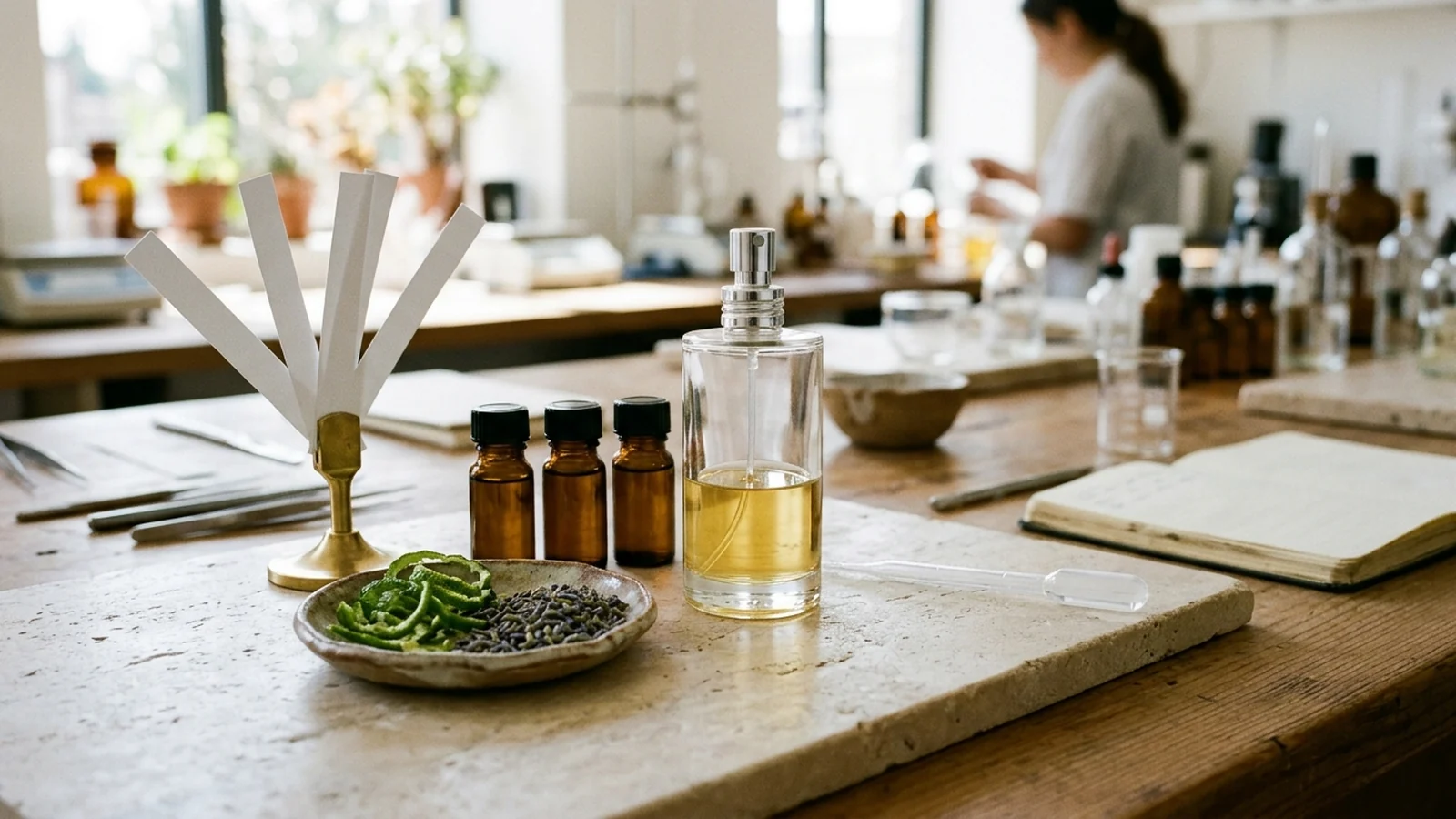
During storage and exposure to light, heat, or oxygen, monoterpenes such as limonene, linalool, and α-pinene can form terpene hydroperoxides, epoxides, aldehydes and ketones, and secondary rearrangement products, where limonene can be converted into limonene hydroperoxides, linalool into linalool oxides, and pinene into pinene oxides, and these oxidation products are responsible for changes in aroma profile with the development of off-notes and loss of freshness. In a near-empty bottle with 50–80% air headspace, headspace oxygen drives oxidative degradation reactions where terpene top-note compounds are highly susceptible to oxidation, producing off-notes (limonene oxidises to produce peroxide compounds with a harsh, resinous edge), some aldehyde compounds polymerise under prolonged air exposure, and certain esters can hydrolyse slowly in the presence of water vapour introduced with each use; one management option to reduce headspace is to decant remaining fragrance into small 5ml or 10ml glass vials with tight seals.
In a full bottle with 5–10% air headspace, oxygen exposure is limited to the small air gap and dissolved oxygen in the solution, and a full bottle stored correctly can maintain its formulation integrity for 3–5 years in many cases.
| Storage Factor | Stability Threshold |
|---|---|
| Full Bottle Headspace | In a full bottle with 5–10% air headspace, oxygen exposure is limited to the small air gap and any oxygen dissolved in the solution itself, and a full bottle stored correctly can maintain its formulation integrity for 3–5 years in many cases. |
| Depleted Bottle Headspace | A 100ml perfume bottle at 20% full has four times the oxygen-rich headspace of one at 80% full, and bergamot's limonene oxidizes into camphoraceous, dull carvone and limonene oxide. |
| Arrhenius Thermal Kinetics | According to the Arrhenius equation formalized in 1889, every 10°C increase in temperature roughly doubles the reaction rate, so a bottle at 30°C degrades approximately twice as fast as one at 20°C and quadruples at 40°C, with an ideal range of 15–20°C (59–68°F). |
| Solar Photodegradation | Certain aroma compounds exhibit half-lives as short as 1.3 hours under direct summer sunlight, and visible light alone degrades certain fragrance notes by 30% over six months. |
| Reference Cold Storage | Clause 5.3.2 of ISO/TR 18811:2018 states that refrigeration at 5 °C (2 °C to 8 °C) / ambient humidity may be used to store samples to be used as reference samples, a freezer at −5 °C to −10 °C may be used to determine the effects of extreme low temperature, for example during transportation, and moderate elevated temperature (e.g. 37 °C to 40 °C) is a more realistic condition for predicting in-market stability than temperatures far removed from ambient. |
How Does Fragrance Oxidation Alter Top Notes and Prehapten Chemistry?
Terpenes in essential oils are constructed from isoprene units of 5 carbon atoms, classified into hemiterpenes (1 isoprene unit, 5 carbon atoms), monoterpenes (2 units, 10 carbon atoms), sesquiterpenes (3 units), and diterpenes (4 units) up to 8 units. A prehapten is a non- or low-sensitising chemical that is transformed into a hapten outside the skin by simple chemical transformation such as air oxidation or photoactivation without specific enzymatic systems, whereas a prohapten is transformed into a hapten in the skin by bioactivation usually via enzyme catalysis.
Autoxidation of fragrance prehaptens is a free radical chain reaction in which hydrogen atom abstraction in combination with addition of oxygen forms peroxyl radicals, showing selectivity for positions where stable radicals can be formed. Fragrance substances investigated for autoxidation have oxidisable allylic positions able to form hydroperoxides and/or hydrogen peroxide as primary oxidation products upon air exposure, while secondary oxidation products such as aldehydes and epoxides can also be allergenic.
Geraniol forms the aldehyde geranial, epoxy-geraniol, and epoxy-geranial via both autoxidation and metabolic oxidation pathways. Oxidation products of commonly used fragrance terpenes including limonene, linalool, geraniol, and linalyl acetate have been identified as potent sensitisers in predictive animal tests, whereas caryophyllene is readily oxidised but has a low sensitisation potency after autoxidation. Perfumes usually contain 15-30% fragrance concentrates, and terpene oxidation typically begins with the formation of unstable hydroperoxides that further break down into epoxides, aldehydes, ketones, and alcohols in reactions that can be autocatalytic, while ultraviolet (UV) radiation can initiate free radical reactions, high temperatures accelerate molecular movement, and low concentrations of metal ions can catalyze oxidation processes.
Why Do Headspace Air, UV Light, and Heat Degrade Opened Bottles?
A 100ml perfume bottle at 20% full has four times the oxygen-rich headspace of one at 80% full, and bergamot’s limonene oxidizes into carvone and limonene oxide with a camphoraceous, dull profile. In Alison Crowe’s WineMaker Magazine guidance on managing headspace in a carboy, she advises not to rely on carbon dioxide or gas blanketing alone because gases do not stay in neat layers very long and mix every time the carboy is bumped, temperature changes, or barometric pressure shifts, so eliminating headspace by filling up into the neck or topping into a compatible smaller container is recommended.
According to the Arrhenius equation formalized in 1889, every 10°C increase in temperature roughly doubles the rate of chemical reactions, so a bottle stored at 30°C degrades approximately twice as fast as one at 20°C and quadruples at 40°C, with an ideal range of 15–20°C (59–68°F). Research on fragrance photodegradation has shown that certain aroma compounds exhibit half-lives as short as 1.3 hours under direct summer sunlight, while a study cited by L’Oréal’s research division found that visible light alone degrades certain fragrance notes by 30% over six months.
About 56% of UVA rays can penetrate clear glass bottles, and brief sunlight exposure of 2 to 3 weeks can cause noticeable changes in scent and color. Cosmetic destabilization processes may be triggered or magnified by extrinsic factors including thermal energy loss or gain, light and UV irradiation, mechanical energy input such as vibration or pressure, oxygen uptake, humidity, interaction with the container/closure system (packaging), and proliferation of microorganisms.
How Do Hydroperoxide Formation and Allergen Thresholds Impact Sensory Panels?
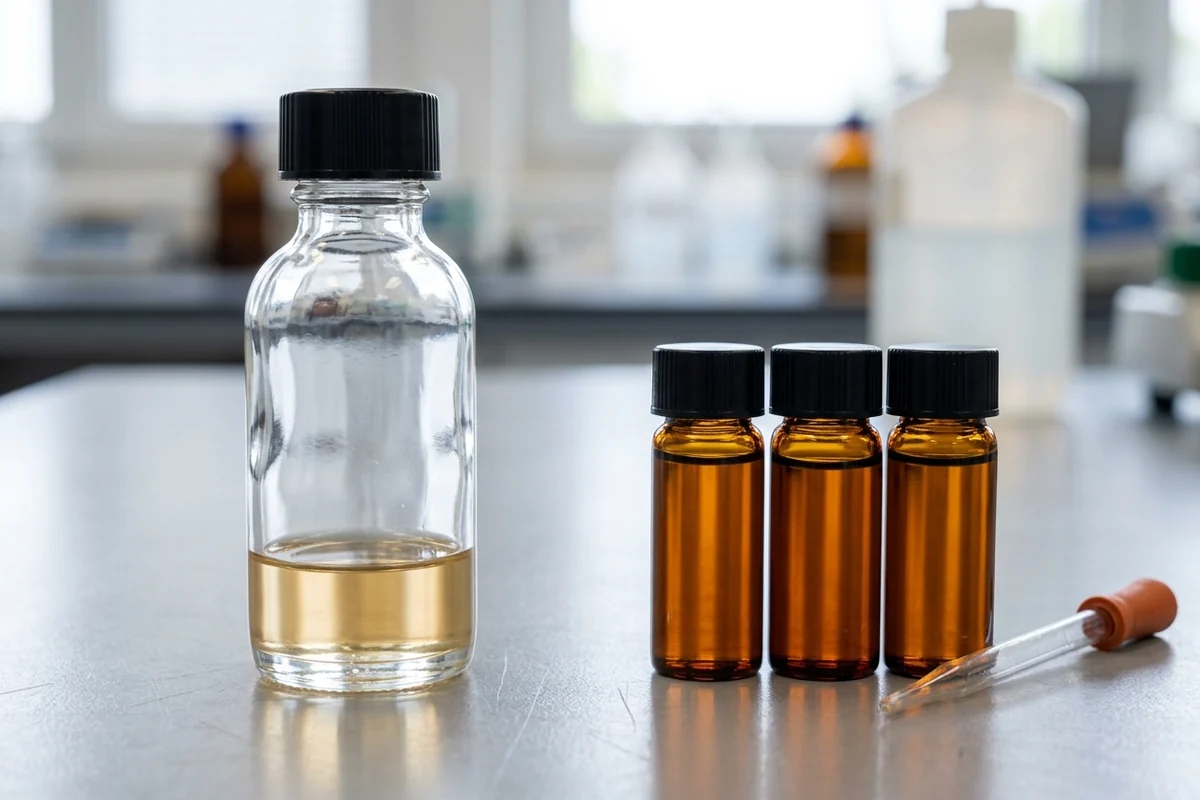
Limonene and linalool oxidise on exposure to oxygen in the air into hydroperoxides which are much more potent sensitisers, and patch testing uses hydroperoxides of limonene 0.3% in petrolatum and hydroperoxides of linalool 1% in petrolatum, read 48 and 96 hours after application. Due to delayed oxidisation after a pack has been opened, sensitised individuals may tolerate a freshly opened product that is used daily at home while an identical older opened product may elicit an allergic dermatitis reaction.
In a consecutive patch test study of 821 patients tested with hydroperoxides of limonene 0.3% pet. and hydroperoxides of linalool 1.0% pet., positive reactions were observed in 77 patients (9.4%) to hydroperoxides of limonene, 96 patients (11.7%) to hydroperoxides of linalool, and 38 patients (4.6%) to both. In the 821-patient cohort, patch testing with d-limonene 2.0% pet. and linalool 10.0% pet. produced 1 positive reaction per allergen in 2 different patients. In patch test studies with over 3,000 dermatitis patients, 5–7% showed positive reactions to oxidized linalool at concentrations used for testing.
Under Annex III to the EU Cosmetics Regulation, fragrance allergens must be mentioned in the list of ingredients on the packaging when their concentration exceeds the threshold of 10 ppm (0.001 %) in leave-on products and 100 ppm (0.01 %) in rinse-off products. Air oxidation of prehaptens can be prevented to a certain extent by measures during handling and storage of ingredients and final products to avoid air exposure and/or by adding suitable antioxidants such as butylated hydroxytoluene (BHT), whereas alpha-terpinene from tea tree oil can be oxidised into skin-sensitising derivatives.
IFRA notes in its specification for linalool that adding 0.1% BHT or α-tocopherol has shown good effectiveness in reducing peroxide formation, while typical levels of 0.01–0.10% are cited for BASF’s oil-soluble phenolic antioxidant Tinogard TS, although BASF explicitly notes that the optimal level depends on the individual formulation, packaging, and required long-term stability. In hand and body lotions, chelants such as disodium EDTA may tie up multivalent metal ions that promote oxidation of unsaturated compounds and growth of microorganisms, while antioxidants such as tocopherol or BHT are used with the intent of reducing oxidative processes.
How Should Sensory Control Samples Be Stored, Aliquoted, and Shielded?
ISO/TR 18811:2018 (Cosmetics — Guidelines on the stability testing of cosmetic products) is a Technical Report prepared by Technical Committee ISO/TC 217 that reviews bibliographic references as a scientific framework for assessing cosmetic stability, without aiming to specify the conditions, parameters, or criteria of stability testing. In Clause 5.3.2 of ISO/TR 18811:2018, temperature and humidity storage conditions might experience a variation, for example ±3 °C and ±5 % RH, and listed accelerated stability storage conditions include (30 ± 2) °C, (37 ± 2) °C, (40 ± 2) °C, (45 ± 2) °C, and (50 ± 2) °C for durations from one week to three months where relative humidity may be ambient or controlled, such as 37 °C to 40 °C/75 % to 80 % RH, while alternative temperature and humidity conditions may be used, including an intermediate condition of (30 ± 2) °C and 65 % RH.
Clause 5.3.2 of ISO/TR 18811:2018 notes that moderate elevated temperature (e.g. 37 °C to 40 °C) is a more realistic condition for predicting in-market stability than temperatures far removed from ambient, and states that refrigeration at 5 °C (2 °C to 8 °C) / ambient humidity may be used to store reference samples while a freezer at −5 °C to −10 °C may be used to determine the effects of extreme low temperature, for example during transportation. As summarized by Alfa Chemistry, IFSCC Monograph No. 2 lists 4℃/Ambient Humidity as the Control Group for stability testing, while SFSTP categorizes stability testing into minimal, intermediate, and preferred methods (all of which can be used for products with an expected shelf life of 30-36 months) and specifies that products intended for winter use must undergo a two-week 4℃/25℃ cycle test and products intended for summer use must undergo a two-week 45℃/25℃ cycle test.
In Chemists Corner’s cosmetic stability testing protocol, a handy rule of thumb is that a sample stored at 45°C for 8 weeks is equivalent to one year at room temperature (though it isn’t an exact predictor), with standard test temperatures of 50°C, 37°C, 25°C (RT), and 4°C plus 24-hour freeze-thaw cycling and fluorescent box or natural sunlight exposure evaluated following 12 and 52. Per EDQM guidance on essential oils in cosmetic products, to avoid degradation, essential oils should be stored in a clean, dry container of aluminium glazed, stainless steel, or anti-actinic tinted glass that is almost entirely filled and sealed tightly, with the air space optionally filled with nitrogen or another inert gas, and stored away from heat and light, while ISO/TS standard 210: 2023 outlines general requirements and guidelines for packaging, conditioning, and storage of essential oils and ISO 211:2023 outlines general requirements for labelling and marking of containers.
In the Light Transmission Test for pharmaceutical containers, circular sections cut from two or more areas of the container are washed, dried without scratching, mounted on a spectrophotometer, and measured for transmittance at intervals of ~20 nm in the region 290 to 450 nm. In the USP 34 <671> Light Transmission Test table intended for parenteral use (Plastic Classes I-VI and Glass Types I, II and III), observed light transmission limits between 290 and 450 nm are 25% for 1 mL, 20% for 2 mL, 15% for 5 mL, 13% for 10 mL, 12% for 20 mL, and 10% for 50 mL, while plastic containers for products intended for oral or topical administration do not exceed 10% at any wavelength in the range from 290 nm to 450 nm. Separately, in Thermo Fisher Scientific’s Smart Notes on Matrix storage tubes, the USP <671> Spectral Transmission section is cited as stating that no more than 50% of light of wavelengths between 290 nm and 450 nm can pass through the material for plastic containers with nominal volumes of 1 mL or less, and Thermo Fisher’s testing showed that less than 10% of light in the spectral range of 290 nm to 450 nm passed through the walls of Thermo Scientific Matrix ScrewTop amber-colored 0.5 mL and 1.0 mL storage tubes.
| Protocol Framework | Protocol Specification |
|---|---|
| ISO Reference Storage | Clause 5.3.2 of ISO/TR 18811:2018 notes that refrigeration at 5 °C (2 °C to 8 °C) / ambient humidity may be used to store reference samples, moderate elevated temperature (e.g. 37 °C to 40 °C) is a more realistic condition for predicting in-market stability than temperatures far removed from ambient, and a freezer at −5 °C to −10 °C may be used to determine the effects of extreme low temperature, for example during transportation. |
| Thermal Cycling | IFSCC Monograph No. 2 lists 4℃/Ambient Humidity as the Control Group, while SFSTP categorizes stability testing into minimal, intermediate, and preferred methods for products with an expected shelf life of 30-36 months and specifies a two-week 4℃/25℃ cycle test for winter-use products and a two-week 45℃/25℃ cycle test for summer-use products. |
| Accelerated Storage | In Chemists Corner's protocol, a handy rule of thumb is that storage at 45°C for 8 weeks is equivalent to one year at room temperature (though it isn't an exact predictor), alongside test temperatures of 50°C, 37°C, 25°C (RT), and 4°C plus 24-hour freeze-thaw cycling evaluated following 12 and 52. |
| Freeze-Thaw Equilibration | Chemists Corner's freeze-thaw stability protocol places test samples in a freezer for 24 hours, removes and allows them to come to room temperature, places them in a 50°C oven, and equilibrates them before evaluating appearance, odor, viscosity, and pH. |
| Amber Shielding | In Thermo Fisher Scientific's Smart Notes on Matrix storage tubes, the USP <671> Spectral Transmission section is cited as stating that no more than 50% of light between 290 nm and 450 nm can pass through the material for plastic containers with nominal volumes of 1 mL or less, while Thermo Fisher's testing showed that Matrix ScrewTop amber-colored 0.5 mL and 1.0 mL storage tubes transmitted less than 10% of light from 290 nm to 450 nm. |
How Do Peroxide Value Titration and Blind Opaque Smell Checks Verify Stability?
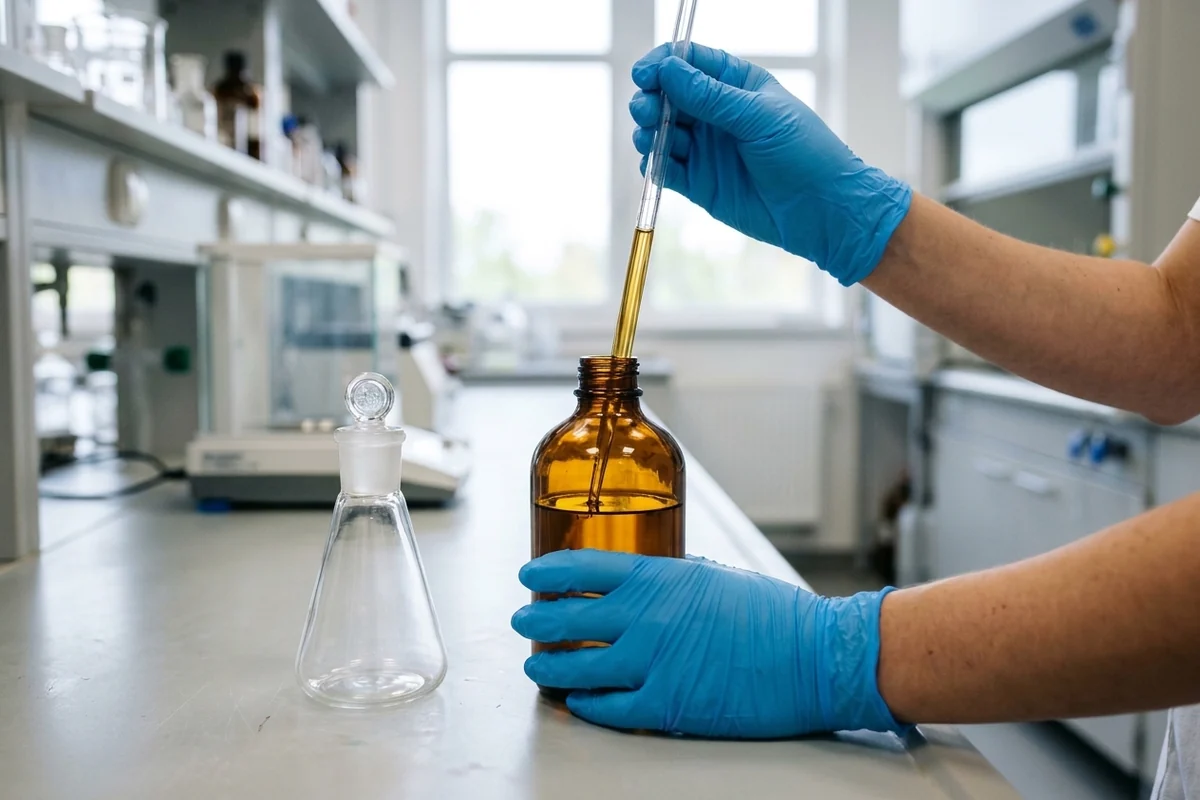
The IFRA Peroxide Value method expresses peroxide values in milliequivalents of peroxide/kg or millimoles of peroxide/L, using 0.1 mol/L sodium thiosulfate solution when expected peroxide values are over 20 mmol/L and 0.01 mol/L sodium thiosulfate solution when expected peroxide values are less than 20 mmol/L or unknown. In the IFRA Peroxide Value procedure, the sample has to be protected from the air, stored in a cool place, and should not be opened before the onset of the determination, and approx. 3 g of the sample is taken from the centre of the sample, not from the surface, into a 250 mL Erlenmeyer flask closed immediately with a glass stopper. Free Fatty Acids Value in volatile oils is determined according to ISO 1242 by acid–base titration with standardized potassium hydroxide in neutralized alcoholic solvent with results expressed as mg KOH per gram of sample (mg KOH/g), and QCL Scientific notes that elevated acidity may indicate hydrolytic or oxidative degradation and poor storage conditions.
Fragrance oil discoloration and oxidation are not synonyms: in oxidising limonene and linalool, citrus notes gradually diminished while woody, acidic and heavier notes became more prominent, whereas a fragrance becoming darker does not prove that meaningful oxidative degradation has occurred, and in soy wax, higher-vanillin and some citrus-containing fragrances can produce visible yellowing within as little as 24 hours. In a sensory study where 54 wine tasters were given a white wine coloured red with an odourless dye, visual appearance influenced aroma descriptors, so comparing an older and newer fragrance sample should be done blind by putting them into identical opaque containers. In Chemists Corner’s freeze-thaw stability protocol, each cycle places test samples in a freezer for 24 hours, removes and allows them to return to room temperature, places them in a 50°C oven, and equilibrates them before evaluating appearance, odor, viscosity, and pH.
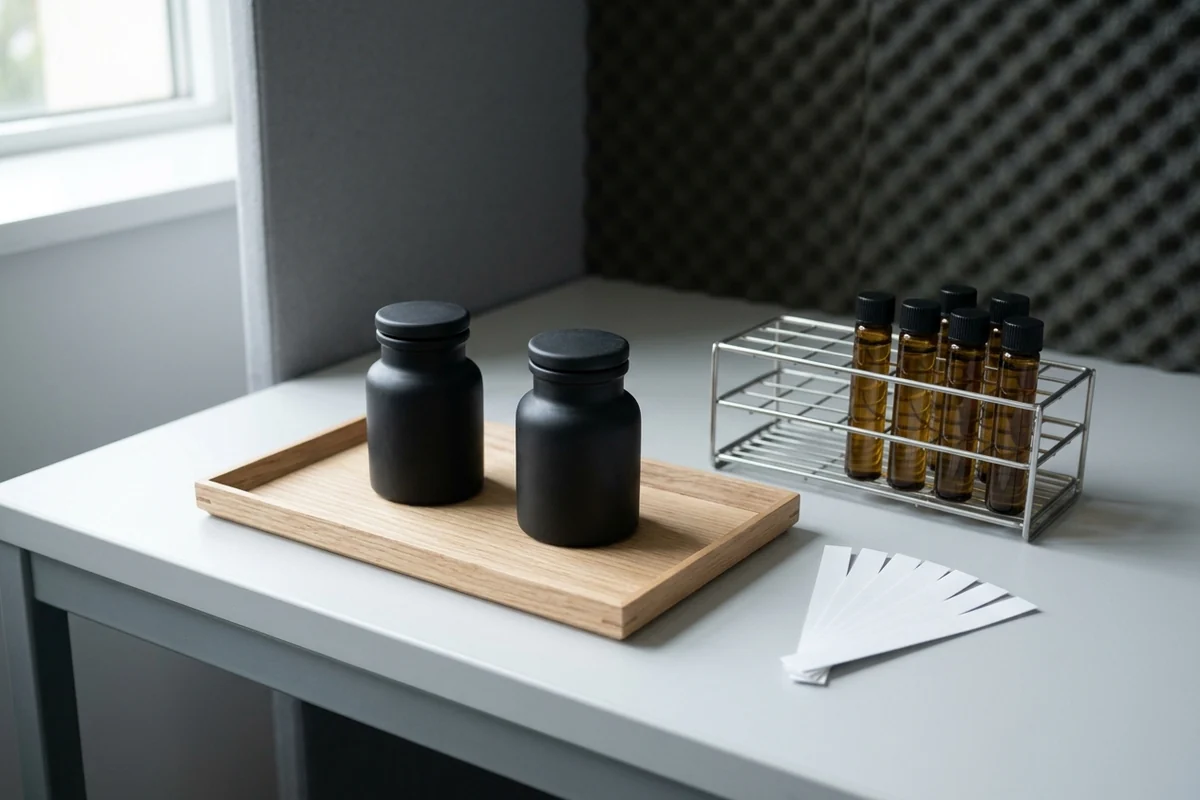
Fragrance & Personal Care Sensory Control Sample Light-Blocking & Seal Inspection Card
| Inspection Step | Verification Criterion |
|---|---|
| Container Fill | Store essential oils in a clean, dry container of aluminium glazed, stainless steel, or anti-actinic tinted glass almost entirely filled and sealed tightly with optional nitrogen or inert gas, per EDQM guidance on essential oils (citing ISO/TS 210:2023 for packaging/storage and ISO 211:2023 for labelling/marking). |
| Spectral Transmittance | Per Thermo Fisher Scientific's Smart Notes on Matrix storage tubes, verify against the cited USP <671> Spectral Transmission requirement that no more than 50% of light between 290 nm and 450 nm passes through the material for plastic containers with nominal volumes of 1 mL or less; in Thermo Fisher's testing, Thermo Scientific Matrix ScrewTop amber-colored 0.5 mL and 1.0 mL storage tubes transmitted less than 10% of light in the spectral range of 290 nm to 450 nm. |
| Cold Reference Chamber | Reference samples may be stored under refrigeration at 5 °C (2 °C to 8 °C) / ambient humidity per ISO/TR 18811:2018; moderate elevated temperature (e.g. 37 °C to 40 °C) is a more realistic condition for predicting in-market stability than temperatures far removed from ambient, and a freezer at −5 °C to −10 °C may be used to determine the effects of extreme low temperature, for example during transportation. |
| Sub-Surface Pipetting | The sample has to be protected from the air, stored in a cool place, and should not be opened before the onset of the determination, after which approx. 3 g is transferred from the centre of the sample (with no sample taken from the surface) into a 250 mL Erlenmeyer flask closed immediately with a glass stopper. |
| Peroxide Value Titrant | Titrate using 0.01 mol/L sodium thiosulfate solution when expected peroxide values are less than 20 mmol/L or unknown, and 0.1 mol/L sodium thiosulfate solution when expected peroxide values are over 20 mmol/L, reporting in meq/kg or mmol/L. |
| Opaque Smell Check | Transfer older and newer fragrance samples into identical opaque containers to hide colour and prevent the visual expectation bias demonstrated in the 54 wine tasters dye study. |
Sources
- European Commission Scientific Committee on Consumer Safety — Opinion on Fragrance Allergens in Cosmetic Products.
- International Organization for Standardization — Cosmetics Guidelines on the Stability Testing of Cosmetic Products.
- International Fragrance Association — Analytical Method for Determination of the Peroxide Value.
- European Directorate for the Quality of Medicines and HealthCare — Guidance on Essential Oils in Cosmetic Products.
- United States Pharmacopeia — <671> Containers – Performance Testing.
- Contact Dermatitis — Contact sensitization to hydroperoxides of limonene and linalool: Results of consecutive patch testing and clinical relevance.
- DermNet New Zealand — Contact Allergy to Hydroperoxides of Limonene and Linalool.
- QCL Scientific — Essential Oils Composition, Applications and Analytical Considerations.
- BTSA — Preventing Terpene Oxidation in Perfume Formulations.
- edpclub — How Bottle Headspace Affects Your Fragrance.
- Première Peau — Perfume Storage: Stop Ruining Your Bottles.
- Goldfield and Banks — Study on How Storage Affects Perfume Performance.
- Perfumedom — Fragrance Oil Discoloration, Causes, Oxidation and Prevention.
- Chemists Corner — How To Stability Test a Cosmetic Formula; Cosmetic Stability Test - Freeze Thaw Cycles; What is in a hand & body lotion, and why?
- Alfa Chemistry — Cosmetic Stability Testing: A Summary of Testing Guidelines from Various Countries.
- WineMaker Magazine — Managing Headspace.